

Op-Ed: What Ciara Miller Revealed About the Rules for Black Women on Reality TV
Reality TV celebrates white women’s meltdowns as iconic, then brands Black women “aggressive” for far less. Ciara knew the difference.

By Latesha Byrd
Black women in the public eye live by an unspoken rule: feel everything, show nothing.
If you’ve been watching Summer House, you know that in late March, Ciara Miller — nurse, model, and Bravo fan favorite — found out through a joint Instagram post that her ex, West Wilson, and her best friend Amanda Batula were officially an item. Not a quiet rumor she could sit with—a coordinated announcement sent to millions of followers.
What did Ciara do? She showed up on a red carpet a few days later and said, with a smile, that she was “thriving.” Then she posted a photo of herself in a blue tracksuit outside Sephora, with the caption: “@sephora actually rewards loyalty.”
The internet erupted. Her castmates praised her. The consensus was: she handled it perfectly. And she did.
Somewhere between the betrayal and that red carpet, Ciara Miller had to make a decision that Black women in the public eye make every single day. She had to choose between what she felt and what she could afford to show.
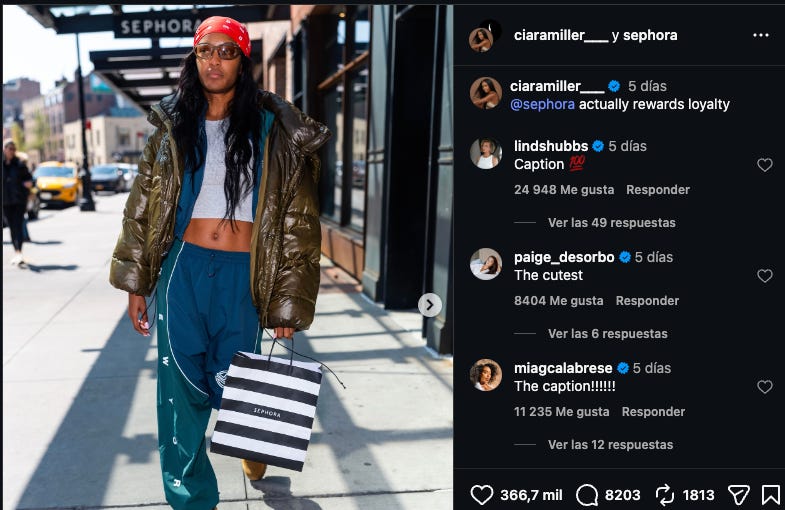
The double standard hiding in plain sight
Let’s be honest about what the reality TV landscape rewards. White women who flip tables, throw drinks, scream, cry, and spiral get GIFs, tribute videos, and Halloween costumes made in their honor. Their worst moments become their most iconic ones.
The mess is their brand.
Black women on the same shows operate under an entirely different set of rules. When we express pain loudly, we’re called aggressive. When we cry, it’s called dramatic. When we set a boundary, it’s called difficult.
The same fire that makes a white cast member a fan favorite makes a Black cast member a liability to producers, to brands, and to the algorithm.
This isn’t a perception problem or a sensitivity issue. It’s a structural one. And Ciara Miller, whether she thought about it in these terms or not, navigated it flawlessly. She gave the world just enough to know she’s okay and not a syllable more.
How composure turns into pressure
There’s a culture that made her choices necessary. Composure is a tool. But when composure is the only tool available to you, when expressing pain publicly puts your livelihood at risk, what you’re left with isn’t strength. It’s pressure with nowhere to go.
And pressure with nowhere to go becomes something else over time. It becomes anxiety that wakes you up at 3 am. It becomes an exhaustion that has nothing to do with your schedule. It becomes the slow erosion of trust in people, because the last time you trusted someone, they announced their relationship on a Sunday, and you found out with the rest of the internet.
This is why the most important thing women of color can do is build a private space where the performance stops entirely.
The spaces we need to build
I’m grateful to have a community of women around me, professionally and personally, who know the full version of me. Not the LinkedIn version. Not the brand-safe version. The one who ugly cries, who says exactly the wrong thing when she’s hurt, who sometimes needs to be told she’s not crazy before she can think clearly again.
A huge component of being in community with others is that it’s important to build it deliberately, protect it fiercely, and show up honestly in it.
Of course, there are nuances to this experience. I know what some of you are thinking: not every Black woman in the public eye is penalized for expressing emotion. And you’re right. There are exceptions, and representation is improving. I also know that poise is genuinely a value for many Black women, not just a survival mechanism.
Ciara Miller’s Sephora post was brilliant. Her red carpet appearance was powerful. But the version of her that matters most is the one no one saw that weekend. The one who got to be a full human being somewhere safe, with people who loved her, away from the cameras.
That’s what I want for every woman reading this.
 | A guest post by
|