

Your Lower Belly Bump Is Not a Flaw. It’s Also Not Your Uterus
Dr. Hazel Wallace’s viral reel gave thousands of women permission to exhale. But the anatomy behind the lower belly curve is worth understanding accurately.
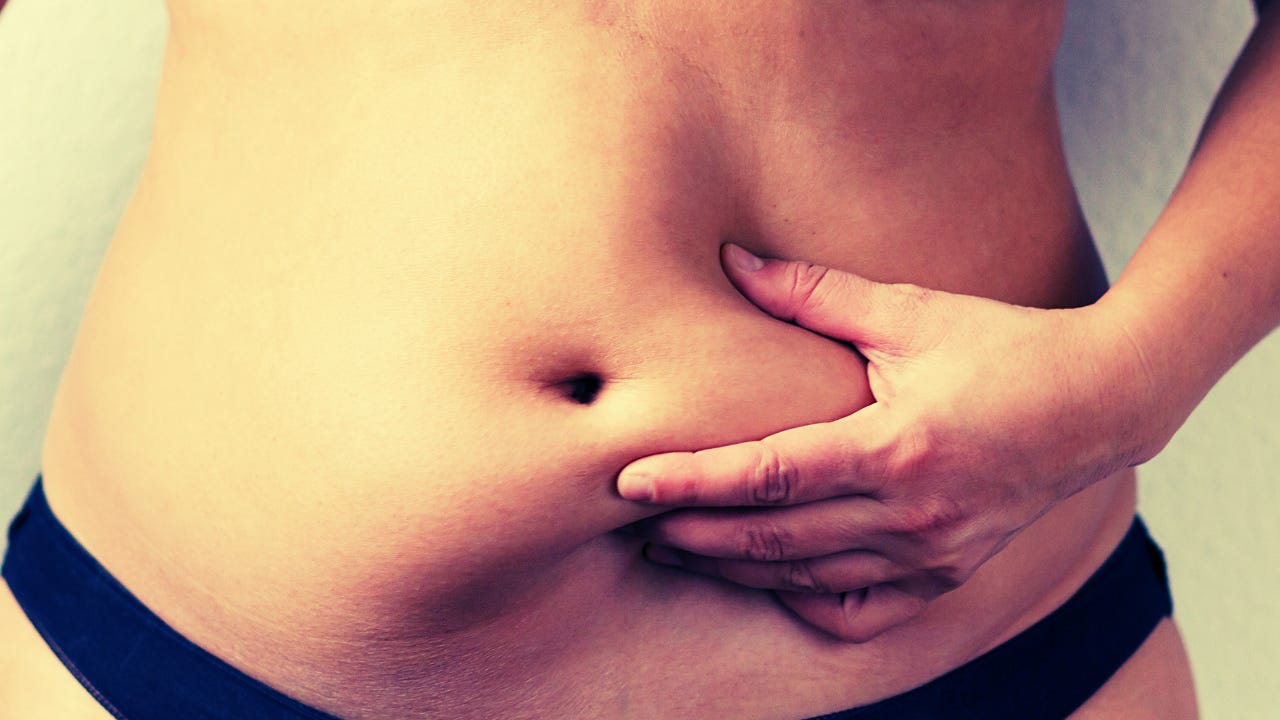
If you were on Instagram this week, you probably saw Dr. Hazel Wallace, calm and direct in front of her camera, explaining that the gentle lower belly curve most women carry is. Her reel went viral for two reasons: first, she made us feel seen with our own private insecurities. And second, because she gently told us it’s ok. “That gentle curve that many women have is completely normal,” she says, “and most of us have it.”
She is, in fact, right. And there is one part of the conversation worth getting more precise about.
Nope, It’s Not Your Uterus
A version of this body-positive message, one that has circulated alongside Dr. Wallace’s reel and others like it, claims that the uterus causes the lower belly curve. That part is a misconception. Dr. Karen Tang, an OB-GYN writing for Katie Couric Media, explains that “a normal-sized, non-pregnant uterus is anatomically situated below or at the level of the pubic bone,” she writes. “It is generally not noticeable physically or visually through the abdominal wall unless you’re pregnant and the uterus is growing, or if you have something like fibroids in your uterus that make it larger.”
What is true is that the curve is normal, common, and for most women, completely benign. It comes from the way fat is distributed in the female body and from where the bowels sit, not from the uterus. Dr. Wallace adds that because of hormonal differences, women typically store more body fat around the lower abdomen than men do. Many women also have a slight anterior pelvic tilt, a forward tilt of the pelvis that makes the curve more visible. And for those of us who notice it getting more pronounced before our period, Dr. Wallace has an explanation for that too: hormonal fluctuations in the days leading up to menstruation are enough to make it more noticeable.
Getting the Anatomy Right Is an Act of Care
When we tell ourselves and each other that any lower belly curve is just the uterus doing its thing, we risk missing a signal worth paying attention to. “Misattributing such a change to a ‘normal uterus’ based on viral content could lead to too many delays in the diagnosis of serious gynecological conditions,” Dr. Tang warns. Uterine fibroids and large ovarian cysts, for example, can enlarge the uterus, creating a palpable mass or a sense of fullness in the lower abdomen.
According to Dr. Wallace, if the gentle curve has always been there and nothing has changed, you are almost certainly fine. “But if you do notice a new lump or bulge that’s getting bigger, or associated with other symptoms like pelvic pain or bleeding,” she says, “it is worth speaking to your GP and getting checked.” For Dr. Tang, the correct path is: if you feel something hard in your pelvis or notice a new bump in your lower abdomen, a visit to a gynecologist and an ultrasound are the right next steps.
The Curve Has More Than One Story
Just as each body is different, each stage of our lives changes that body. For women who have been pregnant, for example, the uterus expands during pregnancy, the surrounding muscles and skin stretch to accommodate it, and after delivery, that skin does not always return to its previous position. The medical term is panniculus: an apron of skin, and sometimes some fat, that can rest below the navel. When loose skin is the cause, exercise will not change it, because the issue is structural, not muscular.
Pregnancy can also cause diastasis recti, a separation of the two long parallel muscles in the abdomen, which allows the belly to protrude forward even in physically active women, according to Healthline. Then, for women navigating perimenopause and menopause, hormonal changes, particularly in estrogen levels, contribute to fat accumulation in the abdominal area, alongside decreased muscle mass and increased insulin resistance, according to Healthline.
Last but not least, the pelvic floor adds another layer. According to Elitone, 42 percent of adult women live with some degree of pelvic floor dysfunction. When the pelvic floor is not activating properly, it can contribute to a persistent lower belly bulge that traditional core workouts will not fix. The issue, in those cases, is coordination and pressure management, not the absence of effort.
The Flat Stomach Was Always the Lie
In the end, it all goes back to aesthetic indoctrination. We have been handed an image — the flat, unmarked stomach — that does not reflect how most female bodies are designed. The pelvis, hormones, and fat differ in each case. The lower belly curve, therefore, is a body working exactly as it was designed to.
What Dr. Wallace’s reel gave millions of women is the permission to stop fighting a feature that was never a flaw. And what we owe ourselves alongside that permission is accurate knowledge. The curve that has always been there, varying with our cycle, shifts with age, pregnancy, and hormones, is ours. But a new lump, a growing bulge, or pain that was not there before do deserve a doctor’s attention.
We have spent long enough being ashamed of normal. We do not have to spend another minute uninformed about it, either.