

Your Kids Say 'Chocolate' Every Day. Do They Know It's a Náhuatl Word?
A new children's board book is making sure bicultural kids grow up with that knowledge from the very beginning.
Hundreds of people responded to Lucía Garrett’s Instagram reel with some version of the same thing: “I had no idea.”
The reel was about Mexican words with Náhuatl roots, such as chocolate, papalote, jitomate, and cacahuate. Words bicultural families use every day, in kitchens and playgrounds and conversations, without knowing they are also living pieces of Indigenous history that have made it into their everyday lives. The comments kept coming. And Garrett started thinking about the children.
“What if our children grew up knowing that from the very beginning?” she says. “What if, instead of discovering this as adults on social media, they simply understood that their language carries centuries of resilience and culture?”
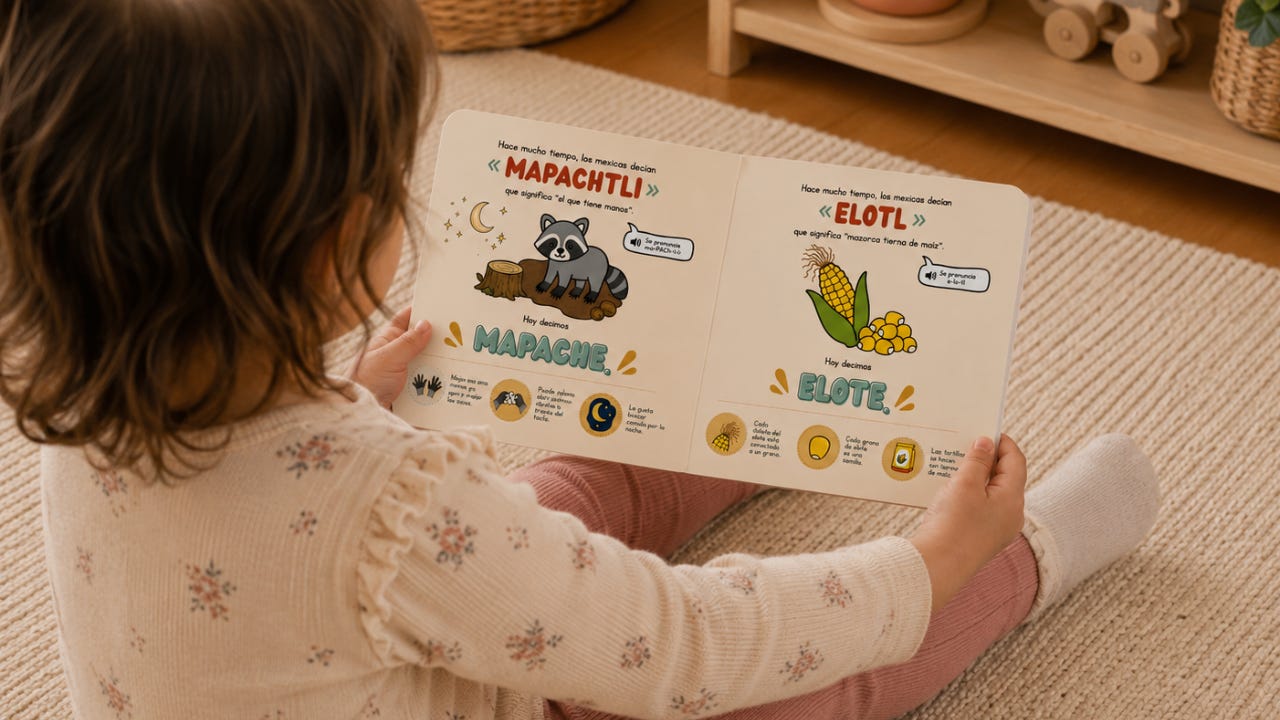
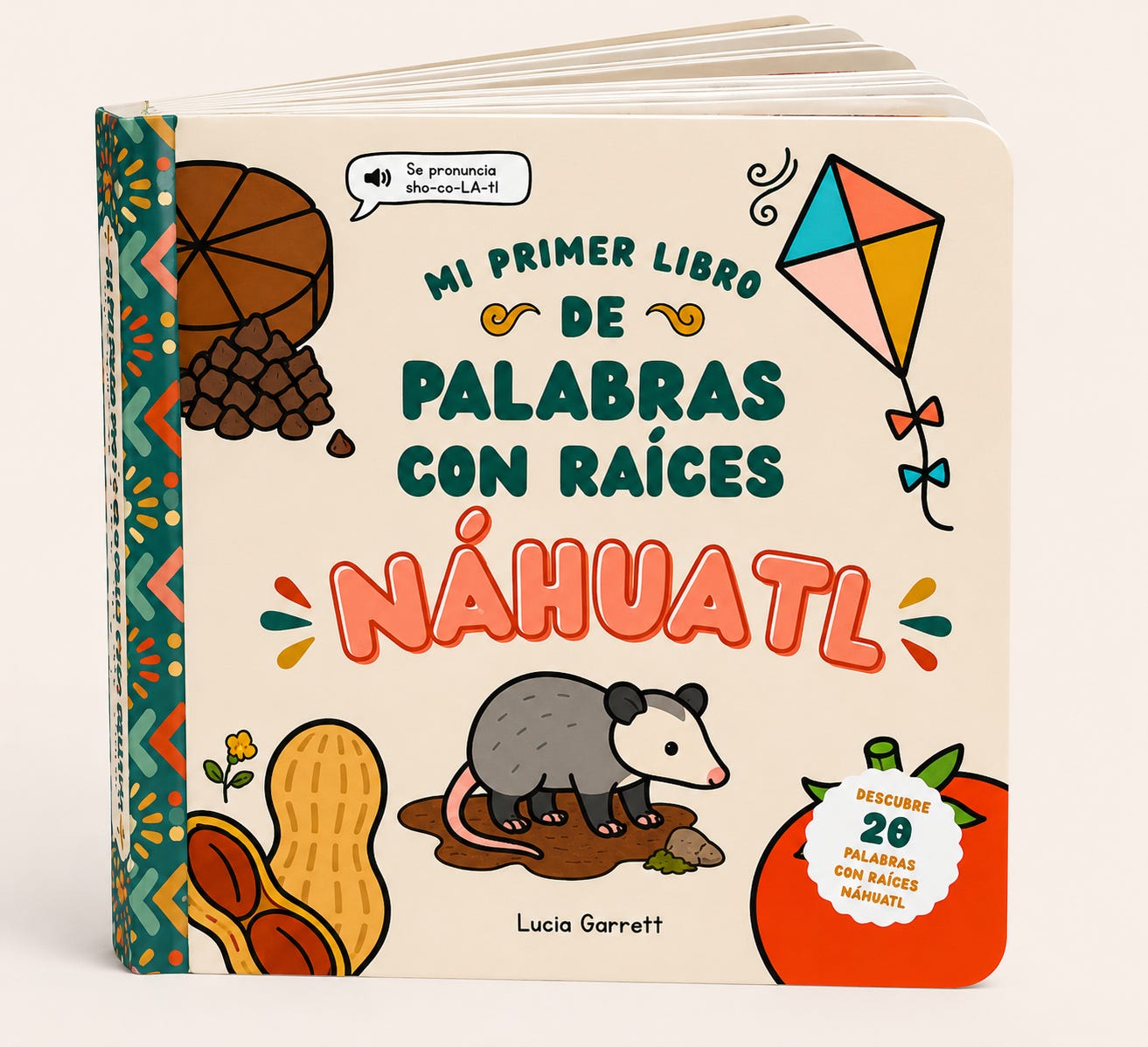
That question became Mi primer libro de palabras con raíces náhuatl, a children’s board book written entirely in Spanish, illustrated by Garrett herself, and available now for pre-order at $13.99 through PatoPato, her children’s brand.
From Reels to Board Books
Garrett created PatoPato around a single goal: removing the barrier between parents who want to share their language and culture and those who actually do. The Náhuatl reel was part of that work. The response to it pushed her further.
“These words don’t belong in a reel that people scroll past,” she says, “but in the hands of the children who will carry them into the next generation.”
The book introduces children to 20 everyday Spanish words with Náhuatl roots through colorful illustrations, pronunciation guides, and fun facts about Mexican history and culture, according to the PatoPato product page. Garrett wrote and illustrated the book herself. It is built as a board book, designed for babies, toddlers, and preschoolers.
How She Chose the 20 Words
The selection started with one standard: words children actually say.
“There are thousands of beautiful words with Náhuatl roots, but I wasn’t trying to make a dictionary,” Garrett says. “I wanted a three-year-old to open the book and immediately recognize the vocabulary.”
She applied three criteria to each word: whether it is part of a child’s everyday life, whether its original meaning or story would surprise both parents and children, and whether it represents a meaningful aspect of Mexican culture, including food, nature, family, or daily life. Because she also illustrated the book, she considered whether each word could support a fun illustration.
Some words she loved did not make the cut. Aguacate, for instance, traces back to the Náhuatl word ahuacatl, which means “testicle.” That one, Garrett notes, may find its way into a future book.
Written Entirely in Spanish
The book contains no English. In a children’s book market where bilingual formats are standard, that is a deliberate choice.
“The connection between papalote and its Náhuatl roots disappears if you replace it with ‘kite,’” Garrett says. “The language itself is the story.”
She sees a specific gap in what bilingual books typically offer. “Too often, that means English is still the default, and Spanish is there as a translation or an addition. There’s a place for those books, but they’re creating a different experience, and they’re serving a different need.”
For the families PatoPato serves, Garrett wants a space where children can think, imagine, ask questions, and discover entirely in Spanish. “This book is creating one small space where Spanish gets to stand on its own,” she says.
For the Child Who Feels In Between
Garrett wrote this book with a specific child in mind: the bicultural child who has absorbed, in some form, the message that they are not Mexican enough or not American enough.
“Children feel connected to a culture when it feels familiar,” she says. “When their everyday is full of its food, its traditions, its stories, its language, and they begin to see themselves inside all of it.”
She describes the moment she hopes the book creates: a child opens it, recognizes a word they already use, and realizes the story behind it belongs to them. “Suddenly, they begin to realize this isn’t just their parents’ story. It’s theirs too. They begin to realize they’re part of something much bigger than themselves.”
The goal has never been to make a child choose. “Bicultural children don’t have to grow up feeling like they have to choose between identities,” Garrett says. “They can fully belong in the country they’re growing up in while also feeling deeply connected to where their family comes from.”
When a parent reads the book aloud and says “chocolate” or “papalote” with their child, Garrett hopes for a moment of shared wonder, a parent learning alongside their child, both of them realizing these words have been carrying a story forward without anyone noticing.
“Helping children realize that the words they speak every day aren’t just vocabulary,” she says. “Son nuestra herencia viva.”