

Women of Color Brought the Real Art to the 2026 Met Gala Red Carpet
At the 2026 Met Gala, women of color transformed glamour into authorship, power, and one of the night’s clearest cultural statements.
The 2026 Met Gala asked a very big question: Is fashion art?
Women of color answered: “Let me show you what art really is.”
Because of all the discourse, all the billionaire controversy, all the “Fashion Is Art” analysis, the clearest argument on those museum steps came through the bodies, silhouettes, references, and risk-taking of women who understood the importance of showing up.
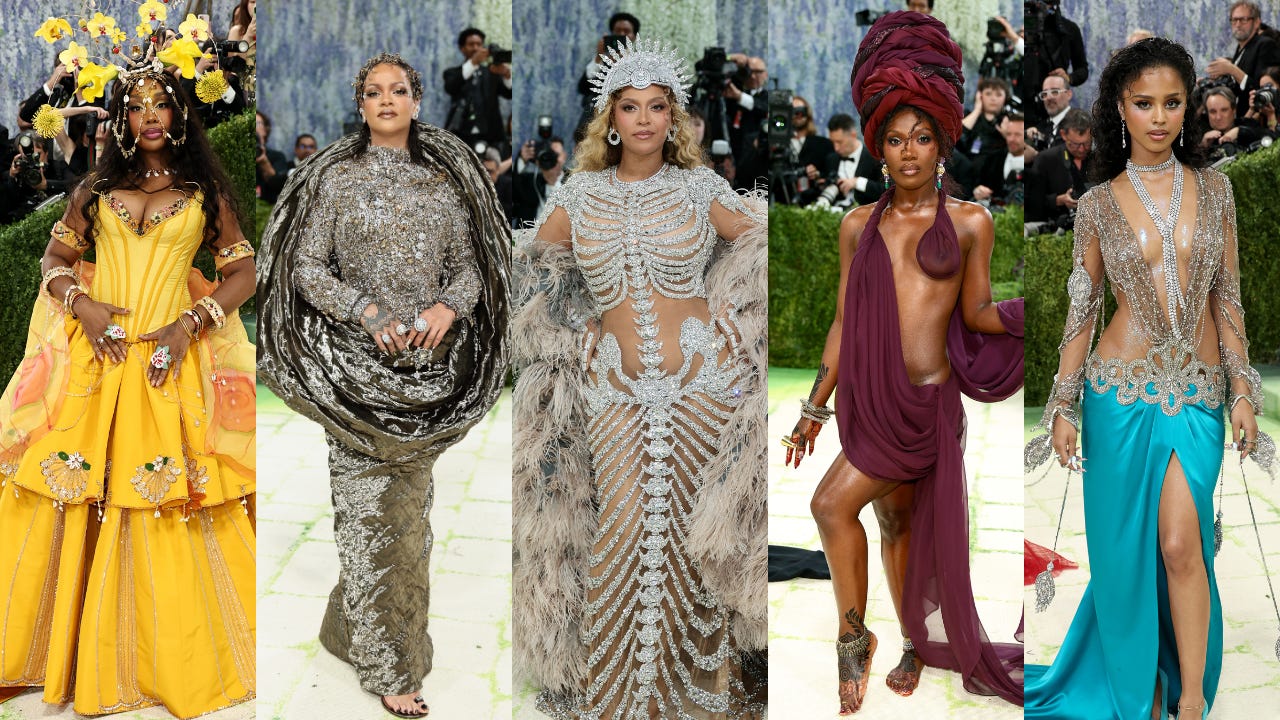
Tyla came in dripping with peacock-colored drama. Beyoncé returned after nearly a decade and turned anatomy into royalty with her daughter by her side. SZA looked like a golden myth built from memory, nature, and fabric. Doechii made burgundy feel dangerous, ceremonial, and completely her own. Cardi B showed up sick, with a fever, and still gave the carpet a Marc Jacobs fever dream.
So yes, the theme had everyone talking. But, as is often the case, women of color did the actual work.
The Met Gala asked if fashion is art, and women of color brought the evidence.
This year’s Met Gala centered on the Costume Institute exhibition “Costume Art,” with the dress code “Fashion Is Art.” According to CBS News, the gala’s co-chairs were Beyoncé, Nicole Kidman, Venus Williams, and Anna Wintour, with Jeff Bezos and Lauren Sánchez Bezos serving as honorary chairs. CBS also reported that the theme drew from the Met’s “Costume Art” exhibit, while the dress code asked guests to interpret “Fashion is Art.”
That context gave celebrities a wide brief. Some could treat fashion as painting if they felt like that was a good approach. Some could treat it as a sculpture. Some could treat it as a performance. Some could treat the body itself as a museum object.
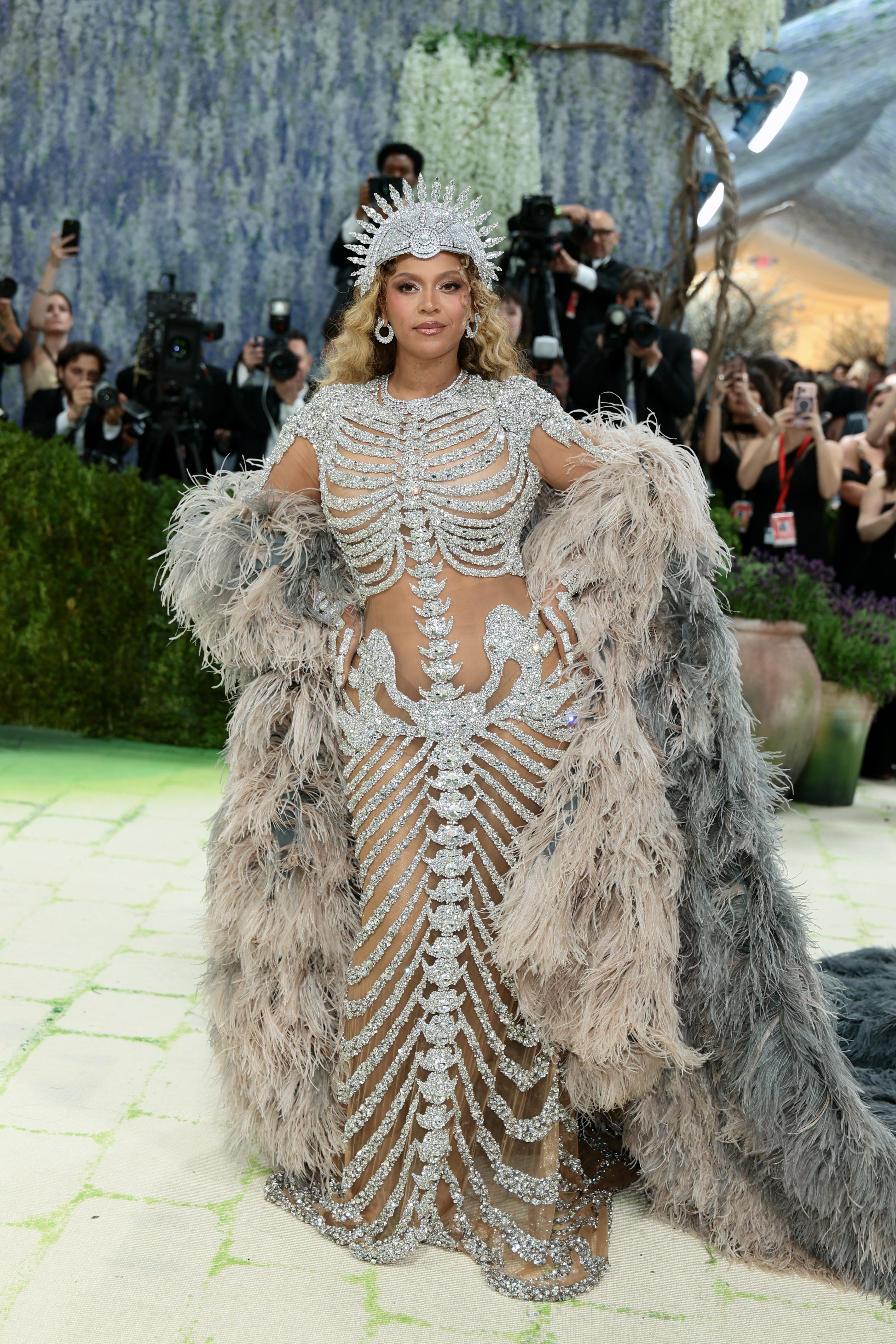
According to Vogue, the exhibit’s focus gave attendees room to explore the classical body, anatomical references, naked dressing, drapery, and the dressed body as a concept. The publication wrote that Beyoncé “shut the red carpet down” in Olivier Rousteing, wearing a body-conscious dress with a skin-tone mesh base and a diamond skeleton that ran down to her fingers.
That was a good way of putting it. Women of color took the moment and rewrote it.
In other words, they made fashion speak volumes.
Beyoncé’s Met Gala return was anatomy, royalty, and total control.
Beyoncé’s return was a symbol in itself.
According to MadameNoire, this was Beyoncé’s first Met Gala appearance in nearly 10 years, and she served as an official co-chair alongside Nicole Kidman, Venus Williams, and Anna Wintour. The outlet also noted that Venus Williams served as co-chair for the first time, while the host committee included Teyana Taylor, Zoë Kravitz, A’ja Wilson, and Misty Copeland.
This means women of color were also behind the scenes, and the evidence was there for everyone to see.
Beyoncé wore a custom Olivier Rousteing sculptural skeleton dress with a cream-and-dust-blue feathered train, finished with a diamond crown. AP reported that she posed on the Met steps with Blue Ivy, also hinting that black women are setting the standard for the next generation.
E! News added another layer to the look through Beyoncé’s hair. Celebrity colorist Rita Hazan told E! that the initial vision was to bring Beyoncé back to the early 1990s with “more honey, chocolatey with some sunny highlights,” a color she called “a Manhattan blonde.” Hazan also said she wanted the look to communicate that Beyoncé, as a co-chair, “is actually all about art and fashion and she’s not afraid to change her look ever.”
After years of Cowboy Carter’s visual language, the warmer hair also served as a deliberate shift from one era to another.
Rihanna reminded the Met Gala arrival is its own art form
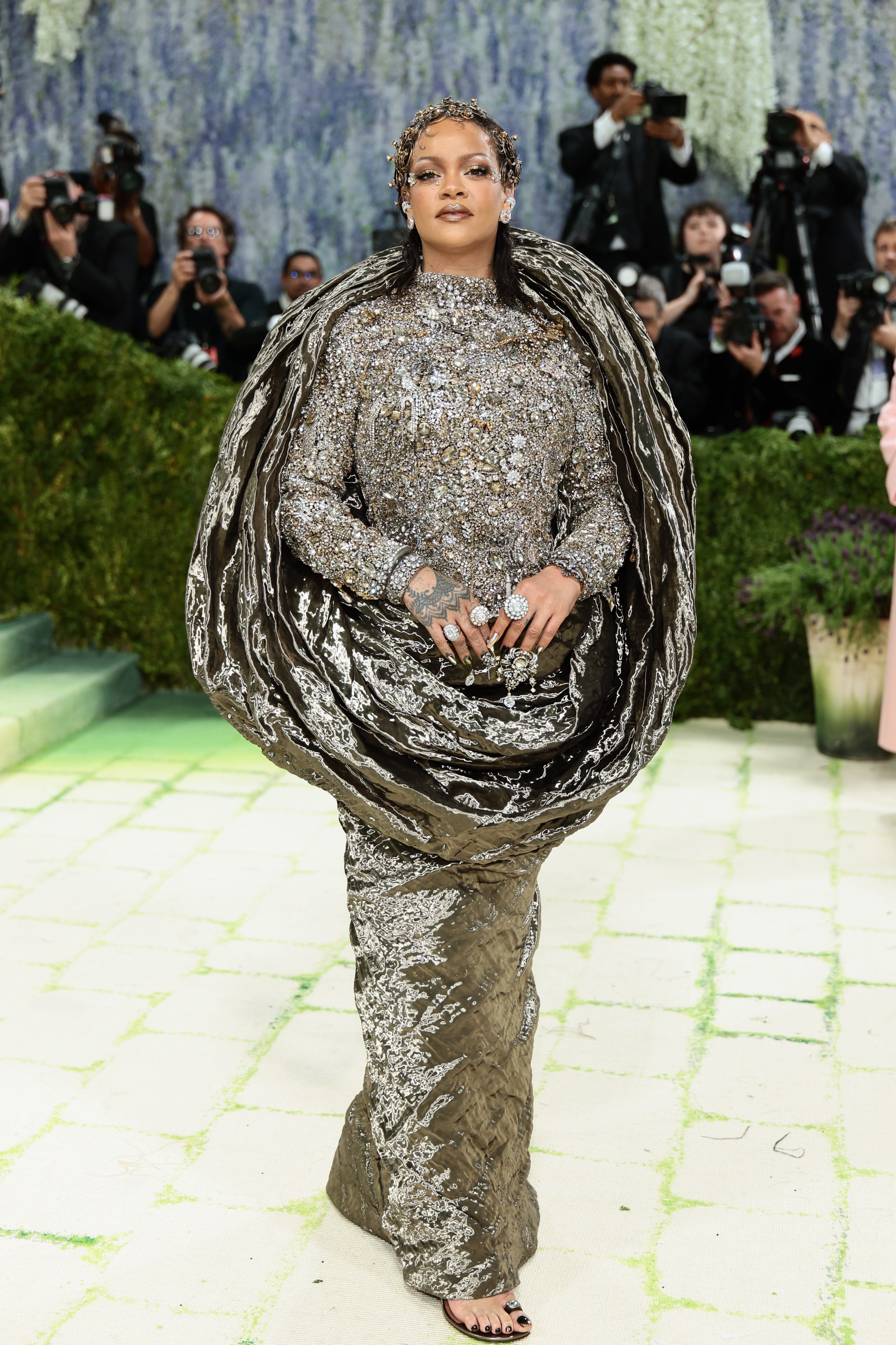
According to Vogue, she arrived in a custom sculptural Maison Margiela look by Glenn Martens, complete with an Art Deco-style headpiece. The gown drew from the label’s Artisanal 2025 collection and used a draped column silhouette inspired by the medieval architecture of Flanders. Vogue reported that the striking gown was sculpted by hand in duchess woven silk, with recycled metal threads typically used for computer wiring, while the corseted bodice featured more than 115,000 crystal beads, antique jewels, and chains. The embroidery alone took 1,380 hours. That level of construction made the look feel less like an outfit and more like a relic excavated from some future cathedral.
Tyla gave the Met Gala another reminder that she understands spectacle.
Tyla has already built a Met Gala reputation most artists would spend a decade chasing.
InStyle published a video of the South African singer making her way from The Mark Hotel to the 2026 Met Gala, a detail that now feels like part of the ritual because Tyla has become one of the red carpet’s most reliable spectacle-makers.
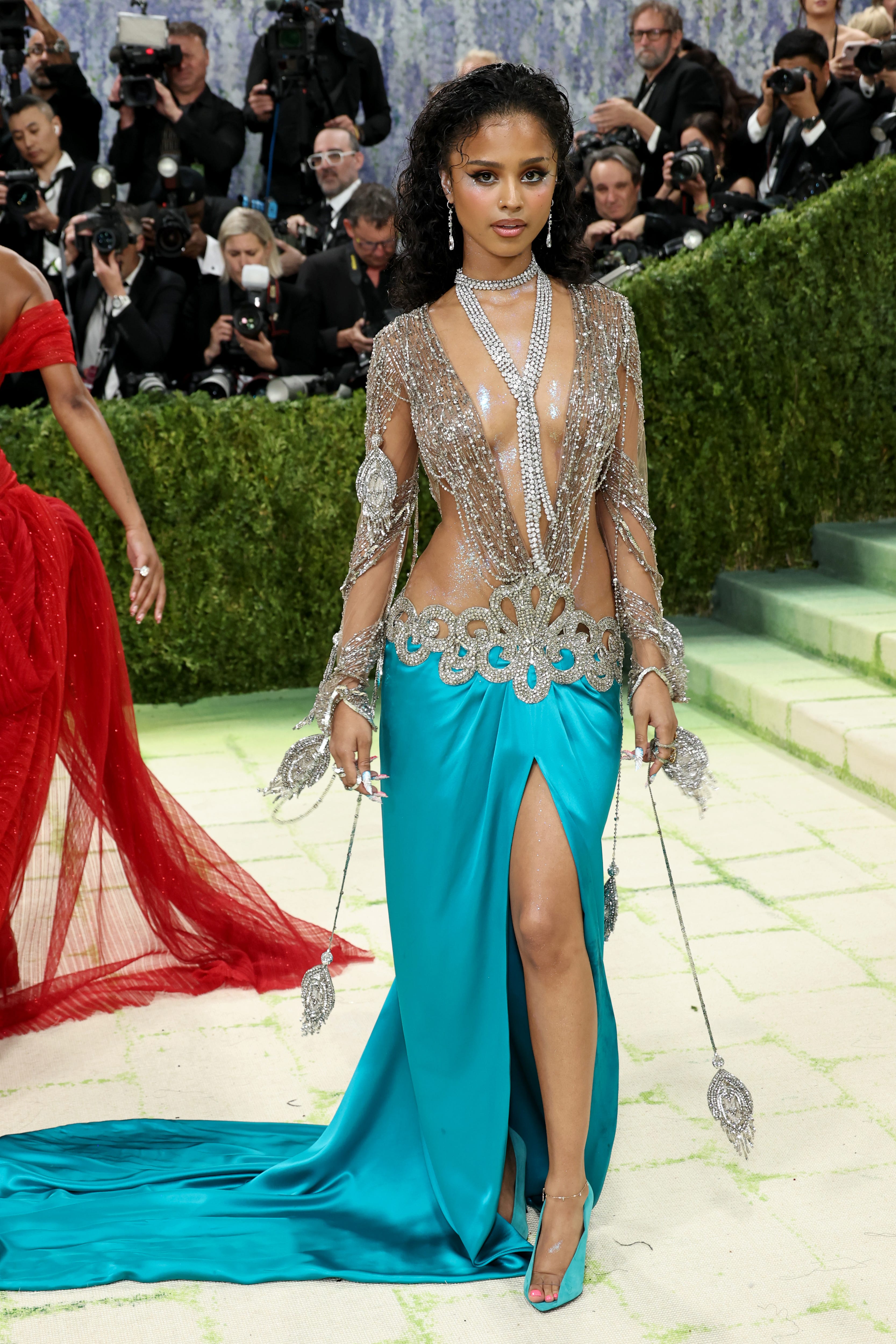
According to Vogue, this year marked Tyla’s third Met Gala appearance, and she wore a custom Valentino look designed by Alessandro Michele. The outfit featured a satin “bleu paon” skirt with a deep slit and an embroidered silver-rhinestone waistline. The tulle top featured long sleeves, a deep V neckline, fringe, and silver sequins. Vogue described the look as “very much giving body,” a fitting choice for an exhibition focused on how fashion interacts with the human form.
Peacock blue can easily become costume territory, but the styling kept the look in the realm of controlled fantasy. She looked like a pop star who also understands that the Met steps are crucial for representation.
SZA turned fabric, insects, flowers, and mythology into a golden vision
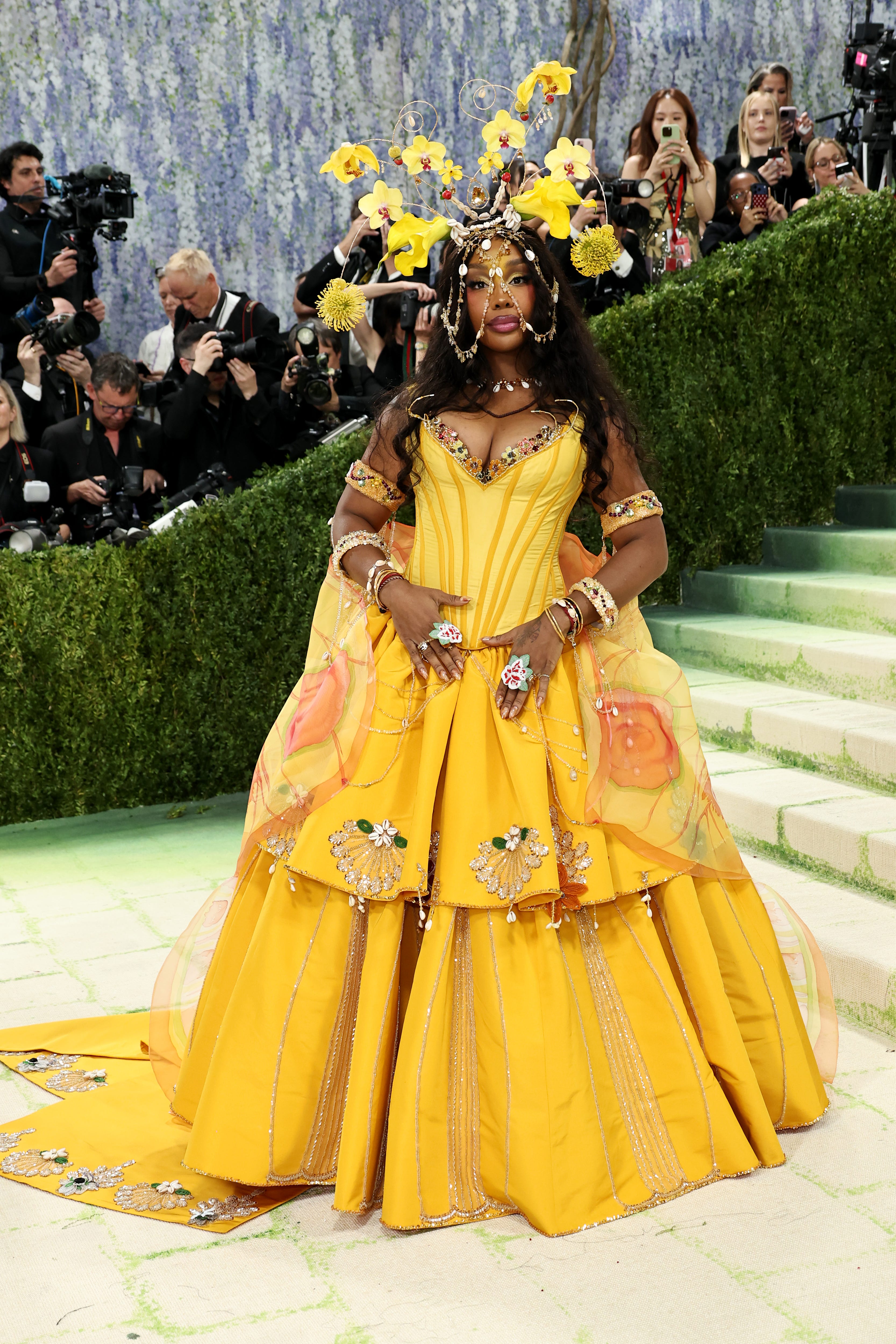
For her part, SZA took a different route.
According to ELLE, SZA attended the 2026 Met Gala in a golden yellow dress designed by Emily Adams Bode Aujla of Bode. The look included a corset dress with a tiered embroidered skirt, made with 100 yards of material sourced from eBay. On the carpet, SZA extended her arms to reveal a sheer butterfly-inspired cape held up by beaded bracelets, with swirling patterns and symmetrical floral details.
The accessories carried the same world-building. SZA wore a matching headpiece decorated with pincushion protea, moth orchids, calla lilies, cowrie shells, and champagne-colored jewels. The designer told Vogue, according to ELLE, that they worked with a vintage dealer who sourced “over a hundred yards of yellow fabrics” in tulle, taffeta, silk faille, and beadwork on lace, and that SZA’s affinity for moths, butterflies, insects, world travels, and specific deities shaped the final look.
Doechii made the Met Gala feel dark, feminine, and fully intentional.
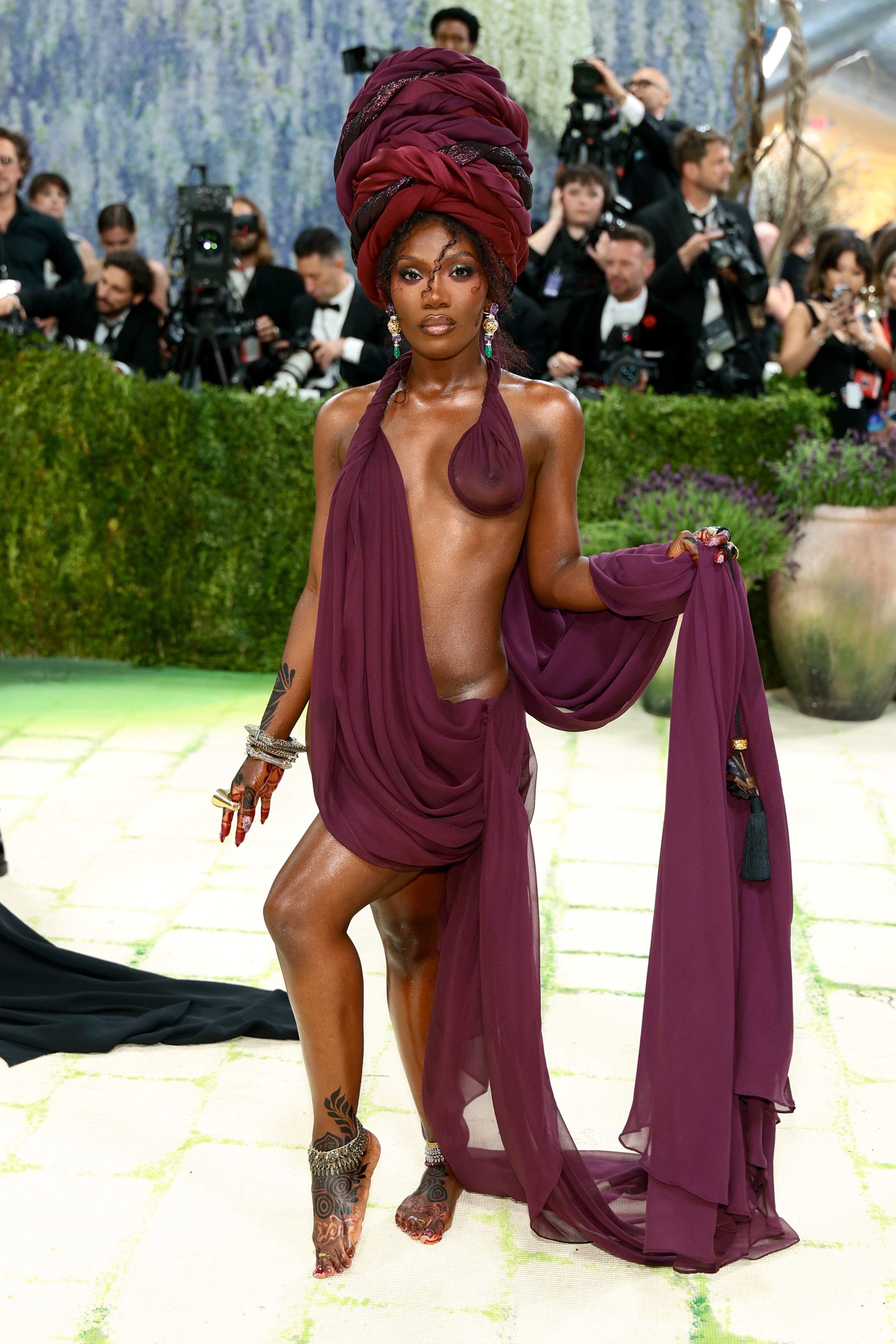
Doechii has become one of those artists whose fashion never disappoints.
At the 2026 Met Gala, she leaned into that reputation. According to Vogue, Doechii made her second Met Gala appearance in a burgundy Marc Jacobs wrap dress, styled by Sam Woolf. Makeup artist Chelsea Uchenna told Vogue she knew the glam would be a “dark, feminine look,” which aligned with Doechii’s “very bohemian, very goddess vibes.”
The details did the rest.
Vogue reported that Uchenna used deep smoky tones and earthy jewel tones, with luminous skin meant to complement the outfit rather than overpower it. Hairstylist Matthew Jean-Pierre told Vogue that Marc Jacobs created the accompanying headpiece, explaining, “It’s actually a hat. I knew the headpiece was gonna be the star of the show, so we didn’t want to do a wig that was too complicated.”
That headpiece became a crown in its symbolism.
Even her nails extended the concept. Nail artist Rachel Sun told Vogue that she originally planned “a simple burgundy cat-eye nail,” but “could not leave it at that for such an iconic person and event.” Sun said the final nail look drew from naturally forming crystal clusters and added, “Art doesn’t demand practicality, and neither should nails.”
Chase Infiniti turned the Met Gala naked body theme into artful control
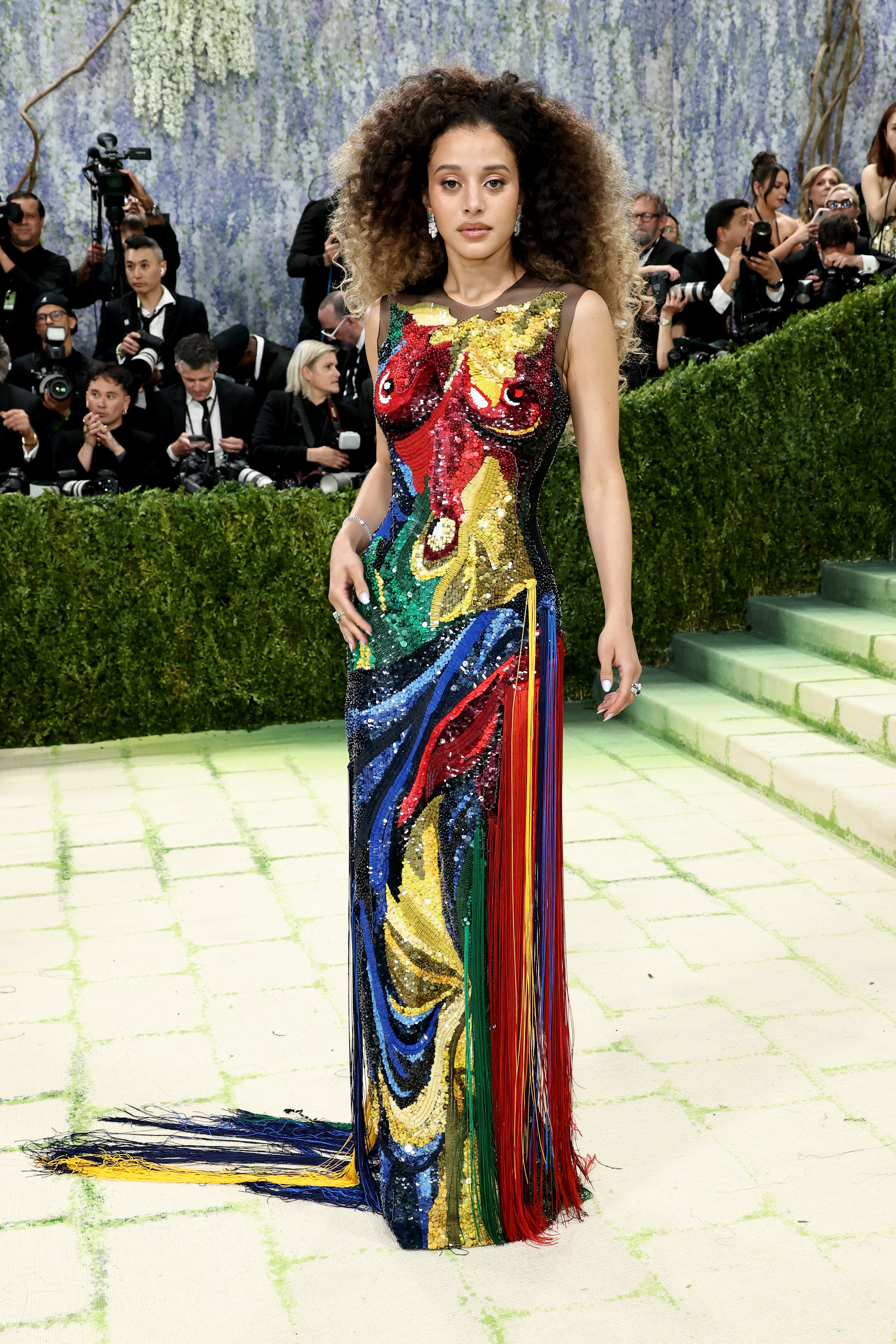
According to Vanity Fair, the One Battle After Another breakout star attended her first Met Gala as a guest of Thom Browne, wearing a trompe-l’oeil nude-illusion dress inspired by the Venus de Milo. Browne dressed each of his guests as an embodiment of sections from the “Costume Art” exhibition, and Infiniti represented the naked body.
But the look pushed far beyond classical reference.
Vanity Fair reported that the dress was fully embroidered with paint-stroke motifs, using more than 1.5 million stacked sequins paired with tiered silk fringe in over 600 different colors, layered to mimic brushstrokes. Infiniti told the outlet, “I love a [red] carpet so much, because I love getting to walk while literally wearing art.” She also said, “I like that it’s really not shying away from the naked body, while still not exposing myself,” adding that the dress was “artistic and tasteful.”
Cardi B showed up sick and still gave the Met Gala a full Marc Jacobs theater.
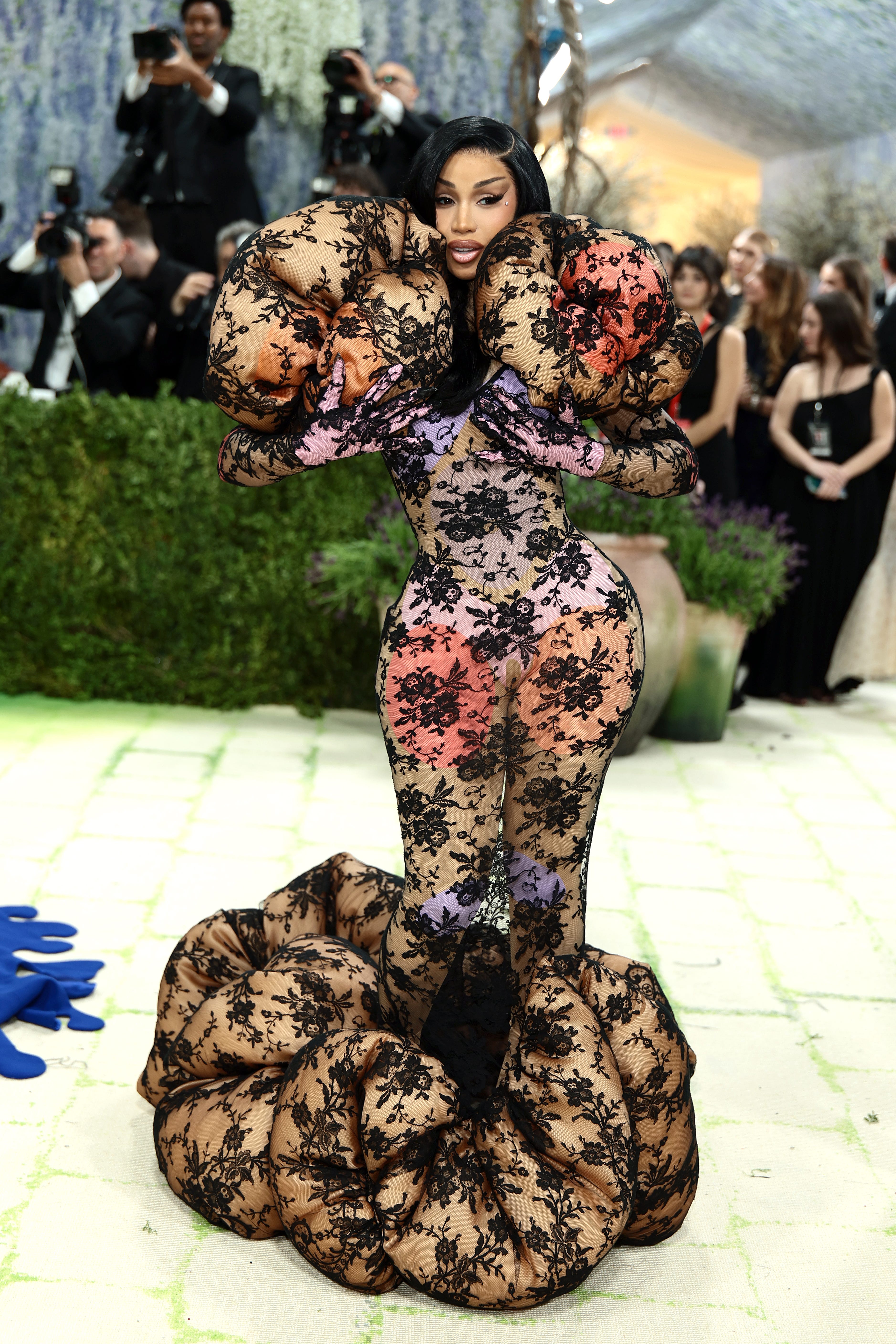
Then there was Cardi B.
Because, of course, Cardi B would arrive battling a fever and still understand that the 2026 Met Gala requested everyone to say “no matter what, we are here.”
According to People, Cardi told reporters on the red carpet, “You wanna know a secret? I’m actually sick, and I have a fever.” People reported that she attended in a custom Marc Jacobs gown from his fall 2025 collection, featuring head-to-toe lace, two large masses around her shoulders and at the bottom of the dress, and colors including purple, pink, orange, and nude, with light pink gloves and black leaf stitching.
CBS News simply reported that Cardi wore Marc Jacobs and noted the exaggerated silhouette. MadameNoire went further, describing the look as sheer black lace with exaggerated puff sleeves, sculptural detailing, a dramatic train, a body-hugging silhouette, pink and purple undergarments, sleek black hair, glowing glam, and a bright smile.
The inspiration made the look even stranger and more compelling. People reported that, according to Vogue, the silhouette took inspiration from German artist Hans Bellmer, known for life-sized female dolls.
Naomi Osaka made the Met Gala feel like the Grand Slam of fashion
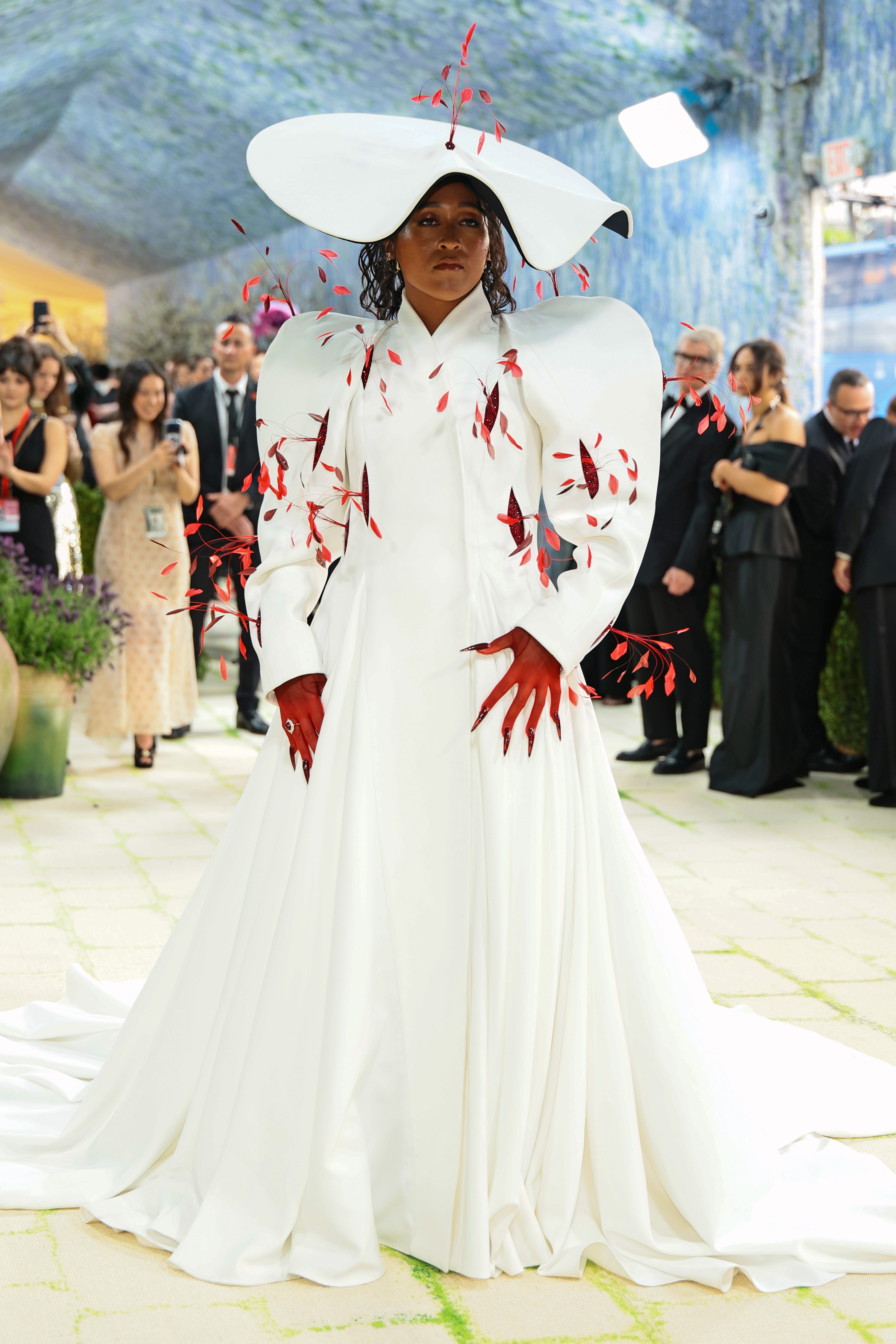
Naomi Osaka also belongs in that conversation because her Robert Wun look was simply perfect. According to Vogue, Osaka returned to the Met steps for the first time since co-chairing the event in 2021, wearing a custom two-piece set by Robert Wun. The designer described the look as a “two-part act” that began with “a sculpted ivory coat, with open seams exposing red crystals from within,” before revealing a fitted red crystallized gown underneath.
Wun told Vogue the gown featured more than 659,000 stitches of embroidery, took over 3,280 hours of handiwork, and used thousands of Swarovski crystals in four shades of red to illustrate human anatomy “needle by needle, crystal by crystal.”
For her part, Osaka made clear she understands the symbolic value of the carpet, telling Vogue, “Obviously, a lot of people know me for my tennis outfits, and the Met Gala is the Grand Slam of fashion.”
Teyana Taylor’s Met Gala look blurred the line between body and art
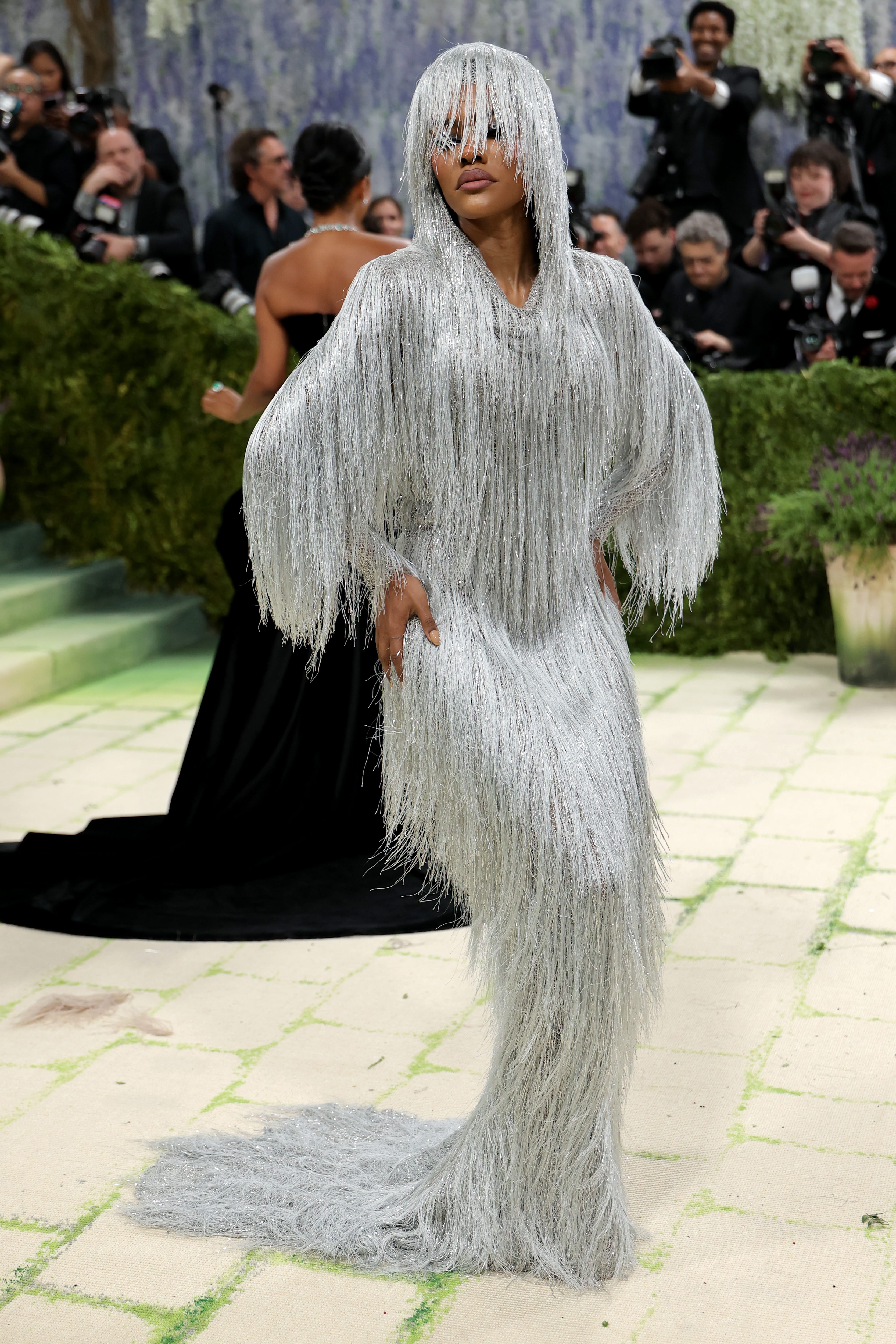
Teyana Taylor, meanwhile, made the body feel like something constantly appearing and disappearing in motion. According to People, Taylor, who served on the 2026 Met Gala host committee, wore a silver fringed Tom Ford gown with a matching fringed headdress draped over half her face. Ahead of the event, she told Vogue, “The outfit is always very, very important to me,” adding, “It looks like it’s melting as I move. I like to think of it as the ‘ghost of a body,’ it appears and disappears, appears and disappears as I’m moving.”
The best Met Gala looks understood fashion as power, not decoration.
The strongest looks of the night did something many red carpets fail to do: they made the body political without feeding the controversy.
For the past few weeks, social media users have called for a boycott of the honorary co-chairs, Jeff Bezos and Lauren Sánchez Bezos, linking the backlash to income inequality, Amazon’s business dealings, and big tech’s role in funding the fashion industry. Similarly, activist groups posted calls to boycott around Manhattan over Amazon’s alleged mistreatment of workers and ties to ICE.
But in the hands of women of color, that context did not disappear once the carpet started. It sat underneath the glamour.
So when women of color dominated the visual conversation, the moment carried a sharper charge. The Met Gala remains one of fashion’s most elite spaces, one tied to money, access, hierarchy, and institutional power. And yet, so much of the night’s actual cultural electricity came from Black women and women of color who transformed that space.