

'Too Gringa for Latinos, Too Latina for Gringos,' Becky G and the Punishment of the Bicultural Latina
A resurfaced debate on X about why Becky G “isn’t bigger” says less about her career than it does about how bicultural Latinas are still asked to prove themselves.
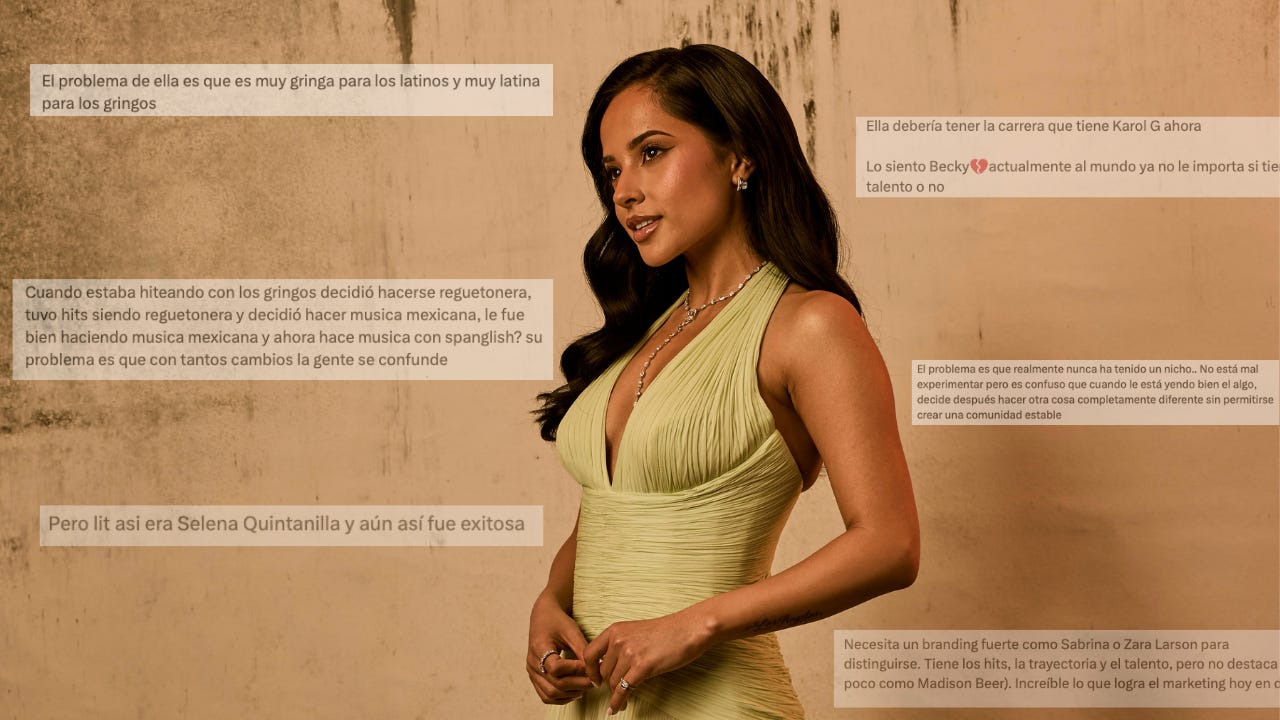
Every few months, the internet rediscovers Becky G and asks some version of the same question: Why isn’t she bigger?
This week, that conversation picked up again on X, mostly in Spanish, with people arguing that Becky G lacks a defined musical identity, shifts genres too often, sounds too American for Latino audiences, or walked away from the wrong lane at the wrong time. Some insisted she should have stayed in English pop. Others said she should have doubled down on reggaetón. Others still argued that she is somehow too “Hollywood” to feel believable as a Latina star.


That whole debate reveals something, alright.
Because the Becky G question has never really been about talent, and it has never really been about whether she has had hits. She has, in fact—many of them. Billboard’s artist pages credit her with 29 top 10s on Latin Digital Song Sales, and Billboard just announced she will be honored at the 2026 Latin Women in Music event, which is not exactly something that happens to artists who failed to connect.
The real issue is that Becky G has spent her whole career sitting in the exact place this culture still does not know how to metabolize: the middle.
Too gringa for Latinos, too Latina for gringos
That tension is not new. Becky G herself explained it beautifully in her 2022 Teen Vogue cover story, when she brought up that scene from Selena where Edward James Olmos tells Jennifer Lopez, “You’re either too Mexican for the Americans or too American for the Mexicans. It’s exhausting.” Becky then added, “It’s this unspoken thing that you can’t be in the middle.”
That is the whole story, right there.
A lot of the commentary around Becky G still treats bilingual, bicultural identity as if it is a branding problem she failed to solve, rather than the actual condition of millions of Latinos in the United States. When she made English pop, plenty of people treated her like a generic industry product. When she pivoted into Spanish-language music, others started policing whether her Spanish sounded native enough, whether her aesthetics felt authentic enough, or if she had somehow “remembered” she was Latina only when it became useful.
That standard is impossible by design.
And it is worth saying clearly that this scrutiny is deeply gendered.
Because nobody is sitting around with this level of forensic obsession about whether Peso Pluma is too this or too that for crossing markets, or whether a male artist’s bilingualism makes him less legible, men get framed as versatile, global, strategic. Women, especially Latinas, get framed as confused, manufactured, or unserious the second they refuse to stay in one tidy box.
The Becky G discourse is really about gatekeeping Latina authenticity
Some of the takes circulating now are not even especially subtle. People are saying she does not “look Latina,” does not sound Latina enough, does not pronounce things the right way, or does not connect because she feels like a flattened export version of Latinidad.
And forgive us for calling a spade a spade, but that is identity policing.
And it gets uglier when you notice how selective the policing is. Eva Longoria has built an enormous mainstream career in the United States without having to prove herself in quite this way every five minutes. Yes, maybe because she had her breakthrough in a very stereotypical show, but still. For her part, Jennifer Lopez played Selena and was embraced as a star powerful enough to carry that cultural symbol. Yet, she has borne the brunt of the worst facet of public scrutiny. Becky G, meanwhile, is still somehow asked to stand there and explain her Mexicanidad, her Americanness, her Spanish, her market choices, and her right to exist in both worlds at once.
That is not because Becky G is uniquely unclear. It is because bicultural Latina women still get treated like they have to pass an authenticity exam that never ends.
Now, let’s make something crystal clear: Becky G is not an almost-star. She is a star whose center of gravity changed
Part of what makes this conversation so irritating is how much it depends on pretending that Becky G somehow never “made it.”
She did. She just did not stay frozen inside the version of success some people preferred.
Teen Vogue reported that after “Shower,” the multiplatinum English-language hit that introduced her to the mainstream, Becky G spent years caught in what she described as “many moving pieces,” including complex contract issues and legal trouble surrounding her early career. She said that point in her life felt like being “tied to a sinking ship.” Most people must’ve forgotten that part, because it complicates the fantasy that she simply wandered away from a perfect English-pop path out of indecision.
Similarly, the shift to Spanish was not a random detour. As she told Teen Vogue, she found “career freedom” performing in Spanish.
And the results were evident. “Mayores” and “Sin Pijama” were major records. Billboard previously noted that “Mayores” and “Sin Pijama” both hit No. 1 on Latin Airplay, and “Sin Pijama” became a top 10 hit on Hot Latin Songs and even crossed onto the Hot 100.
That is not what a stalled career looks like, is it?
So when people ask why Becky G does not have Karol G’s exact career, they are asking the wrong question. These are not interchangeable artists who got graded on the same test. Karol G built one of the clearest and most disciplined emotional brands in pop over the last several years. Becky G built something different. Not better; not worse. Just different.
The “no identity” critique misses the mark by miles
There is a lazy way to read Becky G’s catalog and say it sounds like a blender of genres. English pop here, reggaetón there, regional Mexican somewhere else, Spanglish somewhere in the middle.
But there is another, more honest way to read it. What if her identity is the blender?
That is what second- and third-generation Latino life in the U.S. often sounds like. Not neat purity or a stable genre lane. Not one language used in one socially-approved proportion. Becky G’s career has often mirrored the cultural reality that the discourse keeps trying to punish her for representing.
Teen Vogue described her as a “second-generation Mexican American pop superstar” whose power lies precisely in her bilingualism and multiculturalism. Anitta told the magazine that Becky represents “all the Latinos that live here in America” because “you feel like you belong to both places.”
That is not the absence of identity, if you ask me. That is an identity that many people still do not know how to value unless it is packaged more clearly.
And yes, it is fair to say some listeners prefer one Becky G mode over another. Some like the English-pop Becky G of “Shower.” Others prefer the reggaetón run. Others lit up when she moved into regional Mexican music. That is normal, and very Latino, by the way. Listeners do not have to love every turn. But that is very different from pretending the artist herself lacks shape.
The shape, my gentle readers, is bicultural risk.