

This Juneteenth, We Pay a Long Overdue Tribute to the Black Community's Sense of Unity
A look at how the Black community turned shared struggle into lasting solidarity, and what Latinos can still learn.
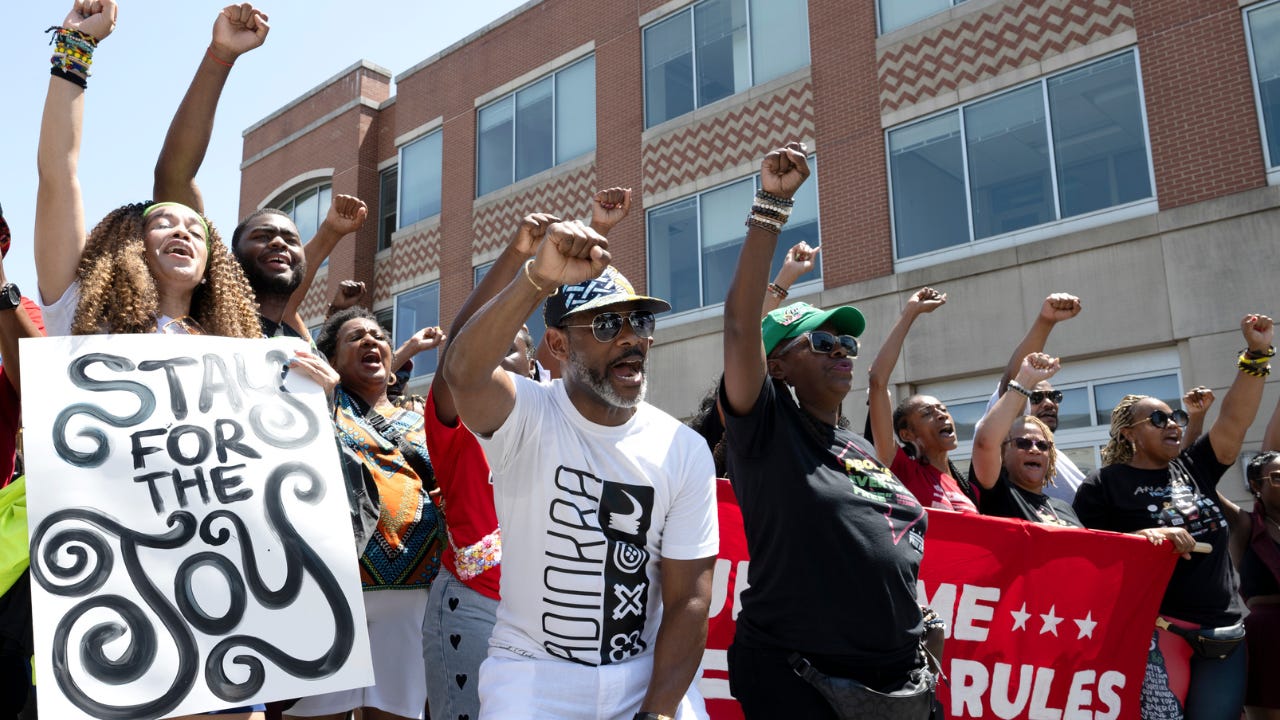
“We may have all come on different ships, but we’re in the same boat now,” said Dr. Martin Luther King Jr. during a speech in 1962. And that’s a lesson the Black community in the U.S. has never forgotten. What’s more, it’s one that the Latino community might need to catch up with.
For a few years now, the conversation about Latino identity in this country has circled back to the myth of the monolith. We are not one thing. Mexican, Puerto Rican, Salvadoran, Dominican, Afro-Latino, Indigenous, recent immigrant, fifth generation, the differences inside that word “Latino” are real, and pointing them out has become commonplace in our own media, including this one. The argument is fair. But lately that conversation feels unfinished. We’re quick to name every fracture within our community and slower to ask how a community broken into a dozen subcategories finds its way back to one another to fight the same fights.
This Juneteenth, I keep thinking about a community that figured that part out a long time ago.
What Juneteenth Actually Commemorates
Juneteenth marks June 19, 1865, the day Major General Gordon Granger stood on Texas soil and read General Orders No. 3, informing enslaved Texans that they were free. The announcement came two and a half years after President Abraham Lincoln signed the Emancipation Proclamation, a delay caused by the fact that Texas had seen little Union military presence and had even become a haven for enslavers fleeing other states. Granger’s arrival in Galveston freed more than 250,000 people still held in bondage.
Juneteenth became a federal holiday in 2021, but freedmen in Texas had already been marking the date as Emancipation Day, Jubilee Day, or Freedom Day since 1866.
The Roots of the Black Community’s Unity
The cohesion Black Americans built afterward was a diligent, almost fervent, process. Generations of chattel slavery, Jim Crow segregation, and exclusion from white institutions pushed Black communities to build their own, the Black church chief among them, alongside historically Black colleges and universities.
Political scientists Ismail K. White and Chryl N. Laird, writing for Princeton University Press, describe how segregation made Black Americans’ social networks unusually interconnected, since exclusion from white neighborhoods, schools, and churches meant Black kinship and friendship circles stayed concentrated within the Black community itself.
When Black Unity Decided an Election in Alabama
White and Laird point to the 2017 Alabama Senate special election as proof that the infrastructure still functions. Republican Roy Moore was expected to win easily in a state Donald Trump had carried by 28 points the year before. Then sexual misconduct allegations surfaced, and Black turnout exceeded 2012 levels for Barack Obama, delivering 96 percent of the Black vote to Democrat Doug Jones, including 98 percent of Black women, according to NPR exit polling. That margin, built through the kind of close-knit social networks White and Laird describe, decided the race.
A Diverse Black Community That Still Moves as One
None of this means the Black community is uniform. The number of Black immigrants in the United States more than doubled between 2000 and 2024, reaching 5.6 million, with Jamaica, Haiti, and Nigeria among the top countries of origin, according to the Pew Research Center. Ideological diversity within the Black community has also grown substantially, with nearly a third now identifying as conservative, up from less than 10 percent in the 1970s, according to White and Laird.
Yet 80 to 90 percent of Black Americans still identify as Democrats, a consistency the researchers attribute to what they call racialized social constraint, the social expectation, enforced informally through families, churches, and friendships, that group unity outweighs individual political drift.
What Latinos Can Learn From the Black Community’s Unity
That’s the footnote that Latino media rarely sit with. We’ve gotten comfortable naming our internal differences. We’re less practiced at building the kind of social infrastructure that turns a fractured population into a force that shows up together, term after term, fight after fight.
The lesson isn’t that Latinos should pretend to be something we’re not. Diversity inside a community and solidarity between its members were never opposites to begin with. The Black community has spent generations proving that a group can hold its differences and its unity at the same time, and that the second one doesn’t have to wait for the first one to disappear.
That’s worth celebrating today, and worth learning from long after it.