

Social Media Made Relationship Expectations Impossible
Since when do strangers get to define your dealbreakers?
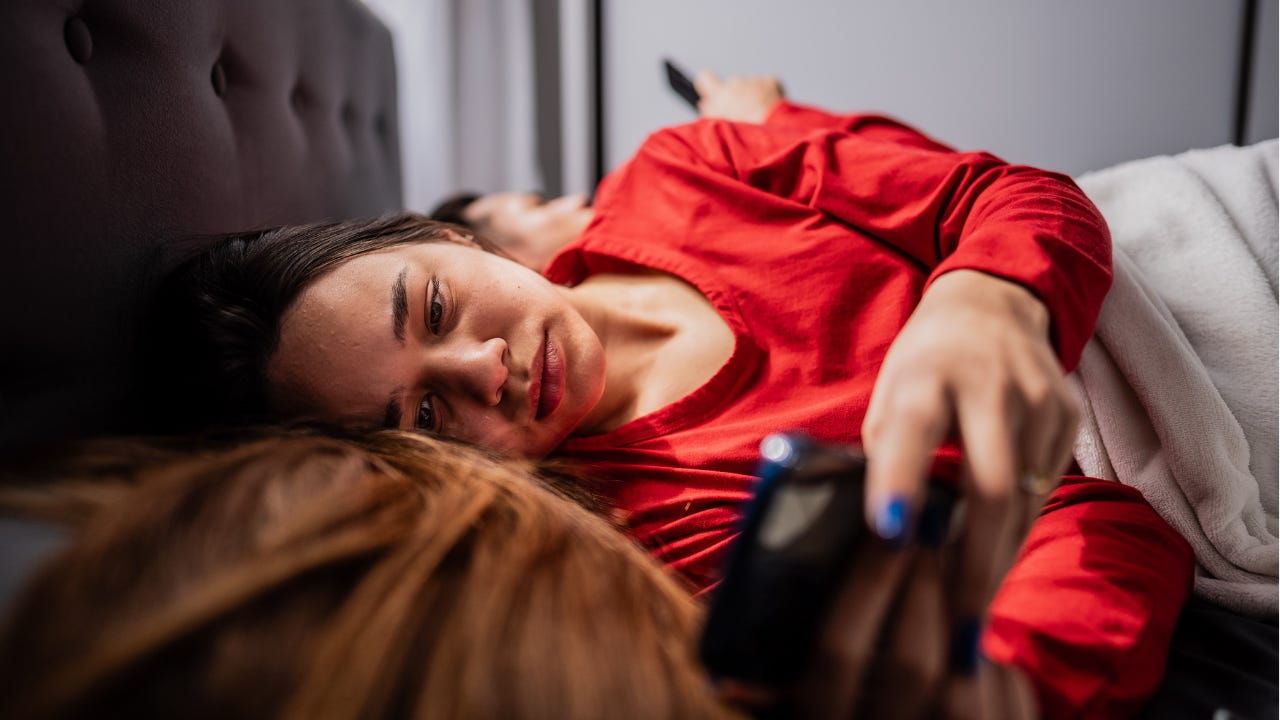
For those of us who grew up in the ‘90s, dating has been a ritual that has evolved over the decades. After all, we’re the last hybrid generation—we’ve experienced life both before and after the internet. While we were the first to experience online dating, meeting people at bars or concerts was a common habit well into our 20s. We knew little about mental health, red or green flags, or the exhaustive categorization of personality traits. We navigated the dating scene blindfolded, trusting our instincts at best, and musical compatibility at worst. The closest we came to the performative nature of relationships was the dreaded moment of introducing someone to the family and saving ourselves from the “So, what about a boyfriend?” for a few months. That is, if you were lucky.
But not having social media everywhere gave us the freedom to make fools of ourselves with our partner choices, or to have the most beautiful love story without leaving any evidence. In the end, it was a win-win. Our failures were ours alone. Our victories belonged to us first, to everyone else later—if we decided to share them at all.
And then social media found us.
Before the Algorithm Knew What Love Should Look Like
Back then, you could date someone for six months, and nobody knew about it except the people you actually told. You could break up, cry into your pillow, process it at your own pace, and move on without a thousand people asking where he went or why you unfollowed him. You could send a terrible text message without agonizing over whether he saw it immediately. You could like a photograph of an ex without triggering a three-hour spiral about what it meant. You could be in love without proving it to anyone. You could be heartbroken without performing your heartbreak for an audience.
Your relationship was yours. Not a content opportunity. Not a reflection of your worth. Not a metric to be measured against someone else’s highlight reel. Yours.
But we gave that up. We handed it over to platforms designed to keep us scrolling, comparing, doubting. And now we’re living in the rubble of that decision.
What Social Media Built in Place of Love
If you’re a straight or bisexual woman, men are expected to do this or that, respond to your texts at this speed, behave in this way, and never forget a list of requirements that reads like a PDF too large to attach to an email. If you’re a straight or bisexual man, the conversation is even more toxic. While there’s still a glimmer of hope in men who talk about emotional availability, healthy relationships, and what it really means to be in a couple, there’s a growing majority that talks about demonizing women as a whole.
For the gays, the dykes, and the dolls, things have always been complicated. But we’ve learned, through years of struggle, having to hide our love away, to build communities. And maybe our straight friends could take a cue. But that’s a conversation for another day.
On Reddit, however, the conversation speaks volumes. A user shared a reel in which an influencer said, “See, this is why I keep telling you girls—never settle for less,” because a guy had written something cute on the back of a bill.
A 16-year-old girl shared that she was so upset that her boyfriend didn’t pay for their date himself, didn’t plan it himself, didn’t know the exact words to say when proposing to be her boyfriend, that she felt he was emasculated. At sixteen. Because social media told her that love is performative, and there’s a rigorous script to follow.
The result? A checkmate that’s eroding the willingness of millions of people to even try to meet someone. According to the Liberty Champion, 34 percent of young adults have felt uncertain or jealous because of how their partner interacts with others on social media. A simple like from an ex, or a misinterpreted comment, can send lovers into a frenzy. And according to research from ManyChat, nearly 80 percent of people have questioned their partner’s fidelity due to social media activity.
We’re not in relationships anymore. We’re in a perpetual state of surveillance, comparison, and doubt.
The Algorithm’s Most Dangerous Invention: Universal Red Flags
Here’s what social media did that might be its most insidious trick: it told us that there’s a universal standard for what constitutes a red flag, a green flag, a healthy relationship, a dealbreaker. As if human connection is a checklist.
The social media algorithm is designed to show you content you’re interested in, but depending on the type of content you interact with, it can backfire. Videos like “5 Ways to Know He’s Cheating on You” or “How to Tell if She has Lost Interest” often show up on people’s feeds, creating new insecurities. When you interact with even one of these posts, more similar videos begin to appear. The algorithm carefully sorts and matches content to audiences with similar preferences. In theory, it’s meant to make scrolling a positive experience. In practice, it’s a tailspin of negative emotions.
But perhaps we should propose a middle ground here: what if, instead of talking like a broken record about mental health, we engage in deep psychoanalysis (or any approach that fits you best)—the kind that takes years and gets to the root of the issue—to understand that the insecurities perpetuated by social media are a simulation that has nothing to do with othersand everything to do with our own demons?
The red-flag content isn’t about your partner. It’s telling you about yourself. About the parts of you that were already fragile, with due reason. Social media didn’t create those insecurities. It just gave them a megaphone. Then, what if we throw that megaphone out the window and look inside? Maybe, just maybe, we will build ourselves so strong that we will have our own irremovable standards. And no influencer is going to tell us how high or low our bar is.
Or, What If We Just Told Social Media to Go to Hell?
Yes, we’ll have our share of failures. But at least the stories we’ll tell over the years will be more interesting. After all, without those stories there would be no music, no poetry. And God knows how much we need music and true poetry these days.
I’m not saying, “Delete Instagram. Delete TikTok. Delete the apps altogether.” You can take a break (or two) and enjoy content about pups and cats, history, or old movies. But those accounts that have convinced you that love is a performance metric? Yeah, they should go to hell. Stop watching people who are making money off your insecurity. Stop measuring your relationship against someone else’s job.
Believe me, the couples who are thriving aren’t the ones posting about it. They’re the ones who turned off their phones, had a conversation without documenting it, made a mistake without an audience, and built something private.
Love doesn’t need an audience. It never did. We just forgot that somewhere between the algorithm and the likes and the comments section. We completely forgot that the most beautiful parts of a relationship are the ones that exist only for you and the person you love.
So here’s what I’m asking: what if we gave ourselves permission to be bored by social media? What if we decided that our love story doesn’t need to trend? What if we actually, truly, turn off our phones and go out and live a little?
I think we’d make horrible mistakes, but we will also remember what love actually feels like.
I needed to read this today.