

She Searched 16 Months for Her Son. The Government Had Already Buried Him
The true story of Carmen Navas, a Venezuelan mother whose desperate search for her imprisoned son exposed a government's systematic cruelty.
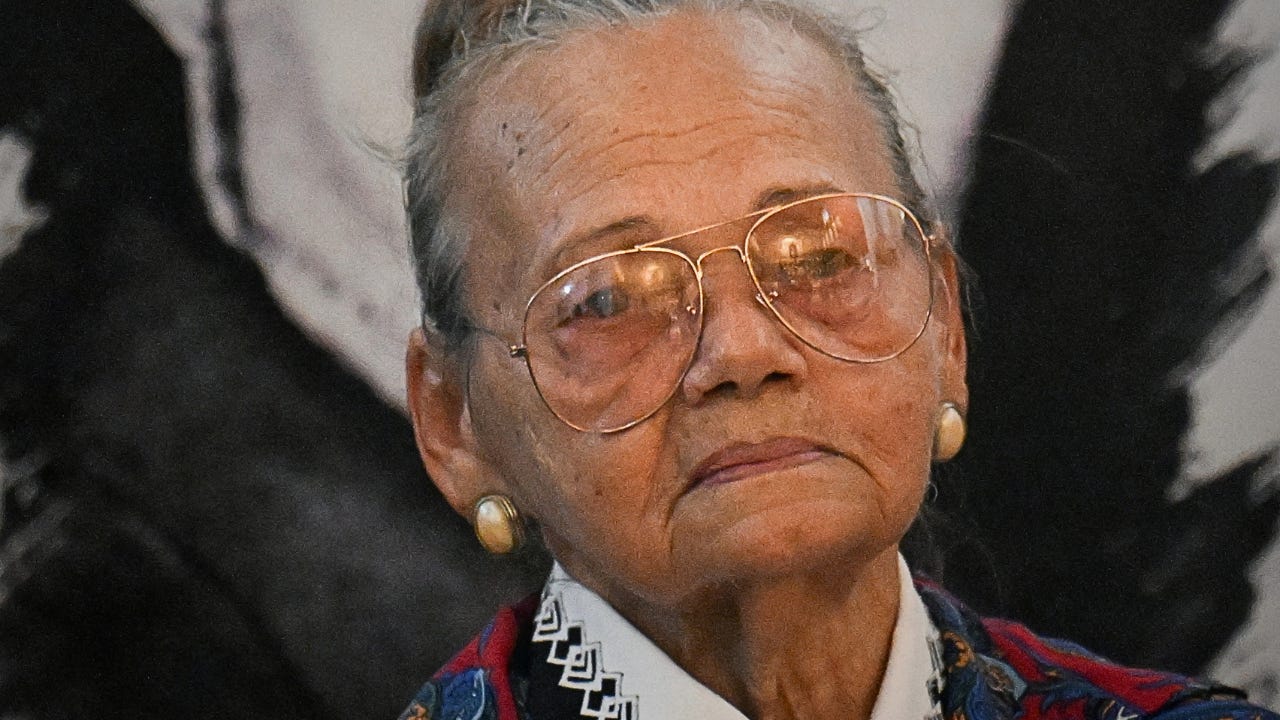
Only over a week ago, Carmen Teresa Navas learned her son had been dead for almost a year. Ten days after she received the information, she passed away.
For more than 16 months before learning the truth, Carmen searched for her son. El País reports she was 83 when she began visiting Venezuelan prisons, hoping to find proof he was alive and that someone could tell her where he was.
On May 7, 2026, officials finally told her the truth. By that time, Víctor had been buried in a secret grave for nearly ten months, and the government had kept this hidden almost as long as Carmen had searched.
The Arrest No One Acknowledged
Víctor Hugo Quero Navas was 51 years old. The Miami Herald describes him as a merchant, while other sources call him a businessman. In early January 2025, officers from Venezuela’s military counterintelligence agency arrested him without a judicial warrant.
The charges were terrorism, conspiracy, and treason to the nation.
But according to the BBC, eyewitnesses gave a different account. They said Víctor was not carrying explosives or weapons. Instead, he had hallacas, a Venezuelan cornmeal dish, and candy. He was on his way to celebrate New Year’s Day with his mother.
What happened next was silence.
Carmen never received an official notice about the arrest. The Miami Herald reports that authorities gave her no information about where her son was, his condition, or his legal status. The system had completely hidden him.
Searching Through Closed Doors
For the next 16 months, Carmen represented a common Venezuelan tragedy: a mother waiting for news that never arrived.
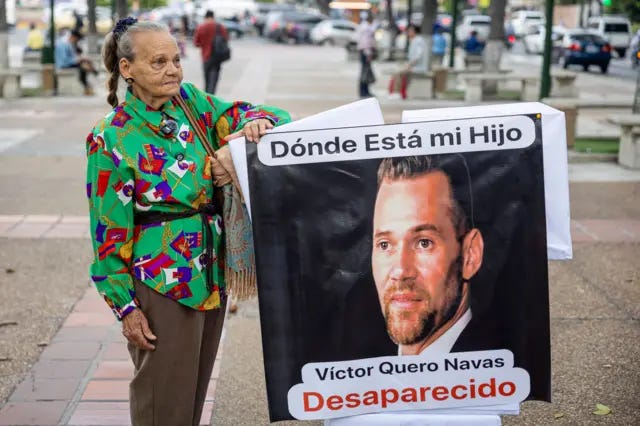
According to the BBC, she visited detention centers across Caracas, including the DGCIM of Boleíta, the Helicoide, the center at La Yaguara, Zone 7 of Petare, and many times to Rodeo I, a maximum-security prison known for its harsh conditions. At each place, multiple sources say officials told her they had no record of her son, no information or confirmation he was alive, and no permission to visit.
But other inmates knew. The BBC reports that prisoners in Rodeo I told Carmen when her son arrived and later when he became ill. The government never gave her this information.
On May 4, 2026, just days before officials told her the truth, Carmen stood in Altamira Square holding a photo of her son. CNN reports she spoke out: “Give me proof of my son. Where are they holding him? If he is alive… because since they arrested him, I have not seen him a single time.”
Her desperate question challenged a system built on disappearances, where people are held in places that officially do not exist, by agencies that deny knowing them.
According to The Miami Herald, human rights organizations had already classified Víctor’s case as a possible forced disappearance. Similarly, according to the Inter-American Commission on Human Rights in April, the commission had granted precautionary measures in favor of both Carmen and Víctor, determining they faced a “serious and urgent situation” that placed their “right to life, personal integrity and health at risk.”
But protective measures on paper meant little against a state system that operated in silence.
The Hidden Death
On July 15, 2025, according to the Ministry of Penitentiary Services statement, Víctor was transferred from Rodeo I to the Dr. Carlos Arvelo Military Hospital. The reason given: he was suffering from “upper gastrointestinal bleeding and acute febrile syndrome.”
Nine days later, on July 24, 2025, he died. The stated cause: “acute respiratory failure secondary to pulmonary thromboembolism”—a blood clot that had blocked his lungs.
After that, there was silence. The Miami Herald reports that authorities said they buried him on July 30 following “legal protocols,” because “no relatives formally requested visitation rights” and because Víctor had allegedly “failed to provide information about family contacts while incarcerated.”
This account could not be true. Carmen had been searching, visiting Rodeo I many times, and going to courts, security agencies, and the Ombudsman’s office. Foro Penal said the government’s explanation was not just wrong but cruel. “Víctor Quero died while he was disappeared!” Alfredo Romero, the organization’s president, wrote on social media. “The Penitentiary Ministry says he provided no family information, but his mother went many times to Rodeo I and authorities denied he was there.”
Nearly ten months went by as Carmen kept searching, not knowing her son had already been buried. The Miami Herald reports that just days before the government admitted Víctor was dead, attorneys with the Coalition for Human Rights and Democracy were still publicly demanding information about his whereabouts, unaware that officials had buried him in secret.
The Exhumation
On May 7, 2026, Carmen was called to the Ombudsman’s office. There, she learned the truth: her son had died almost a year earlier.
Carmen asked for the body to be exhumed so she could identify it herself.
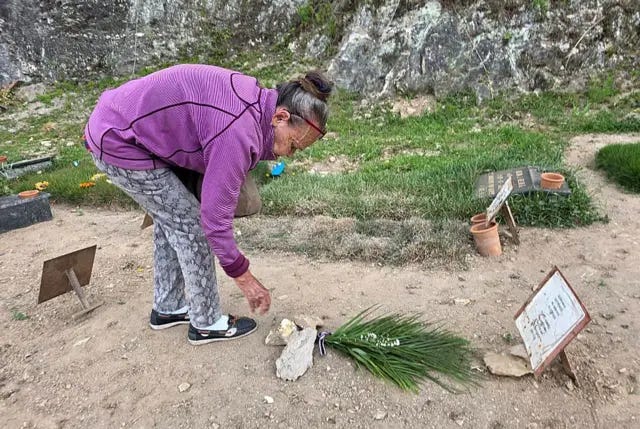
On May 8, the grave was opened. According to the BBC, when Carmen saw her son’s body, she said: “How is it possible they killed him like a dog?”
According to Maryorin Méndez, the journalist who had documented Carmen’s entire search and remained by her side, Carmen was devastated by one detail in the government’s official statement: the claim that no one had searched for her son. “Of course Víctor had family,” Carmen insisted to Méndez.
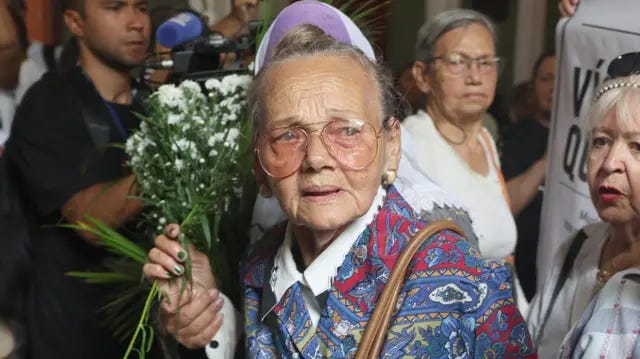
Carmen wanted to give her son a proper funeral. She arranged a mass at La Candelaria Church in Caracas, a large, crowded church where she could finally honor him in public. Dozens of relatives of political prisoners gathered there to acknowledge what the government had tried to hide. Carmen seemed to find a moment of peace. “She said she felt very well, calm despite everything,” Méndez noted.
But something changed after the service ended. Telemundo reports that Carmen tried to speak for her son. “She said it was very hard, that she only asked God for strength,” Méndez recalled. “And after those hours, she faded little by little.”
That night and into Saturday, Carmen felt unwell. She said she couldn’t breathe properly. She was taken to a medical facility, but according to all reports, every test came back normal. The doctors found nothing physically wrong.
On Sunday, May 17, 2026, just 10 days after learning her son was dead, Carmen Teresa Navas died. The cause was never officially released.
Carmen had been waiting for answers about the exact date her son died and the true circumstances of his death. “She said she didn’t believe that date,” Méndez said. Carmen died still waiting for the truth.
The Weight of a Mother’s Loss
Carmen’s death ignited immediate and widespread condemnation across Venezuelan society. María Corina Machado, Venezuela’s opposition leader and the 2025 Nobel Peace Prize winner, was among the first to respond.
“Not only did a mother die; a woman who turned pain into courage and despair into protest was silenced,” Machado said. “Carmen leaves us with an immense lesson in perseverance and dignity. An 80-year-old woman faced, alone and without fear, an entire apparatus of terror that wanted to erase her son and break her family.”
According to UPI, Carmen became known as the “grandmother of Venezuela,” a symbol of the suffering faced by families of political prisoners under the state’s repressive system.
But she was not alone in her grief. According to the BBC, four other mothers whose sons were detained under similar circumstances had died in the previous six months in Venezuela without ever seeing their children freed.
Global Outcry
According to the human rights organization Provea, the cruelty for these families was even greater: “Many times, mothers don’t just have to deal with the vital needs of their sons in prison, where there isn’t even clean water to drink, and a national economy that destroys citizens’ pockets. They also face the pain of not knowing where their son or daughter is—a victim of forced disappearance, a perverse practice increasingly common among state security forces.”
On May 18, the political party Vente Venezuela, led by Machado, released a statement condemning both deaths as inseparable from state cruelty. “Not only did they kill her son, Víctor Hugo Quero, but they forced her to search for him for months, knowing he was already dead.”
According to Venezuelan government sources quoted by The Miami Herald, authorities announced a criminal investigation into the circumstances of Víctor’s death. However, human rights organizations cited in the UPI report warned that any investigation must be independent and have international oversight, not be handled by the same system that had hidden his death.
The NGO Foro Penal, which had accompanied Carmen throughout her search, released a statement to CNN emphasizing her legacy: “Her strength, dignity, and perseverance in the face of silence and uncertainty were an example of the strength of mothers and relatives of victims in Venezuela.”
Carmen had wanted one simple thing: to see her son alive, to know where he was, to be acknowledged as his mother. The government had denied her that. And in the end, it denied her even the time to grieve him properly.
All it left her was 10 days.