

Professional Women’s Baseball Is Back After 72 Years, and It’s Already Sold Out
The WPBL opens Saturday with 60 players from 11 countries, a broadcast deal with ESPN, and more demand than women's baseball has seen since 1954.
Beth Greenwood grew up in Amherst, New Hampshire, dreaming of playing for the Boston Red Sox. A few weeks ago, she threw out the first pitch at Fenway Park. She stood on the mound, took in the stadium, and thought about what comes next. “As a little kid, there was no women’s professional baseball league,” she told New Hampshire Public Radio. “So I just dreamed of playing for the Boston Red Sox.”
On Saturday, as catcher and coach for the Boston Hunters of the Women’s Pro Baseball League, Greenwood gets a little closer to that version of the dream. The league launches its inaugural season on August 1, ending a 72-year gap in professional women’s baseball in America.
And for the 60 women on its four rosters, it is long overdue.
The 72-Year Wait for Women’s Pro Baseball Is Over
The last professional women’s baseball league in North America was the All-American Girls Professional Baseball League, which folded in September 1954 after 12 seasons. Philip K. Wrigley, then-owner of the Chicago Cubs, founded it in 1943 as a wartime measure, reasoning that empty ballparks were bad for business.
In just a few weeks, his initiative became an unprecedented phenomenon. A genuine athletic institution that drew 910,000 fans in 1948 alone, employed more than 500 women across its existence, and established that elite women’s baseball could fill seats.
When the league dissolved, television and the return of male players made its demise feel inevitable, and its history slipped away. The 1992 film A League of Their Own, directed by Penny Marshall, restored it to cultural memory for audiences who had never heard of the Rockford Peaches. But the players had been telling the stories all along.
The Women’s Pro Baseball League traces its own origin to a moment that will feel familiar to many women in sports.
WPBL co-founder and commissioner Justine Siegal was 13 years old when a coach told her baseball wasn’t for her. She spent the following decades making that statement progressively less true. In 2015, she became the first woman to coach a professional men’s baseball team, working with the Oakland Athletics, and the first woman to pitch batting practice in Major League Baseball.
That same year, she founded Baseball For All, a nonprofit that runs girls and women’s baseball tournaments across the country; roughly 25% of WPBL players are Baseball For All alumni. The WPBL formally announced its launch in October 2024. The following summer, open tryouts in Washington, D.C. drew more than 600 players from 10 countries. The WPBL drafted 120 of them in November 2025.
Four Teams, Sixty Women, Eleven Countries
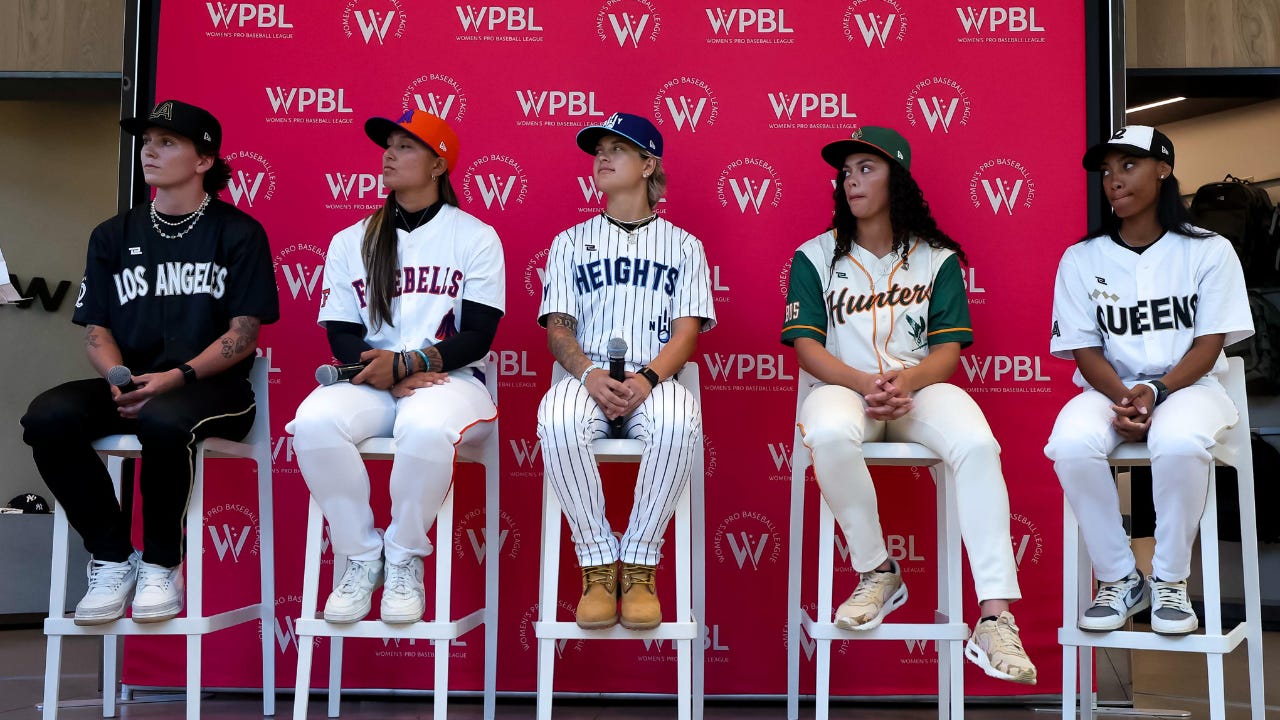
The WPBL’s inaugural season features 60 players from 11 countries, aged 19 to 37, split across four teams: the Boston Hunters, the New York Heights, the Los Angeles Queens, and the San Francisco Firebells. Each team takes its name from a visionary woman of the 19th or 20th century. The Boston Hunters honor Harriet Hunt, who applied to Harvard multiple times, was turned down each time, and kept practicing medicine anyway. “Being told no and doing it anyway,” as Greenwood described her, “and kind of pushing the needle forward.”
The league holds all 30 regular-season games plus the postseason at Robin Roberts Stadium in Springfield, Illinois, a 5,200-seat venue named for the Hall of Fame pitcher born in that city. The approach is careful. The league will keep overhead low, build its fan base in one location, and get operations right before expanding to a traveling model, possibly as soon as next season.
The talent reflects a depth of international pipeline that most American sports fans have never had to follow.
Japan’s Venus League, the world’s largest amateur women’s baseball organization, produced the Queens’ 36-year-old pitcher Ayami Sato, whose 80-mph fastball anchors the rotation, per Front Office Sports. San Francisco selected Kelsie Whitmore first overall, a former USA Baseball player and current Savannah Bananas pitcher-outfielder who received a Division I softball scholarship without ever having played the sport. The Queens’ roster also includes Mo’ne Davis, the 24-year-old from Philadelphia who became the first girl to win a game and pitch a shutout at the Little League World Series in 2014 at age 13, later played softball at Hampton University, and pursued graduate studies at Columbia. The New York Heights open with Team USA players Denae Benites and Kylee Lahners.
The players are, in their other lives, firefighters, teachers, coaches, college students, and parents. Many stepped away from full-time jobs to spend six weeks in Springfield. Twenty-year-old Heights player London Studer took time off from the Columbus Division of Police cadet program to play. Studer told Front Office Sports: “Honestly, if this league really takes off and gets off the ground, like a WNBA-level, they’d never see me again. My dream is for my whole life to be dedicated to this.”
The Latinas in the WPBL
The WPBL’s opening rosters include Latina players on all four teams, reflecting the international scope of the draft and the growing depth of women’s baseball across Latin America and Latino communities in the United States. The inaugural draft’s first nine picks came from five countries: the United States, Canada, Japan, South Korea, and the Dominican Republic, per MLB.com. Mexico and Curacao also placed players in the draft.
Among the Latinas to watch this season: from the Boston Hunters, Maria José Valenzuela, Luciana Moreno, Edith De Leija, and Nadia Diaz. From the San Francisco Firebells, Samanta Gutierrez, Rosi del Castillo, Flor Elena Valerio Montoya, Estheoa Segovia, and Bella Espinoza-Molina. From the New York Heights, Denae Benites alongside Valerie Perez, Diana Ibarra, Angelis Rivera, Rocio Barajas, Angela Valenzuela, and Milanyela Cortez. From the Los Angeles Queens, Samaria Benítez and Luisa Hernandez.
And their presence goes beyond representation. The WPBL creates a professional pathway for athletes who have spent their careers navigating a system that routed girls away from baseball and toward softball, a sport with institutional infrastructure, college scholarships, and broadcast attention that baseball has historically withheld from women. For Latina athletes, who have had fewer visible pathways in both women’s baseball and women’s sports more broadly, making the first professional roster in this sport in 72 years represents something new.
ESPN Is Paying Attention. So Is Everyone Else
Before the Women’s Pro Baseball League played a single game, team merchandise sold out in one day—4,000 orders, $300,000 in total, per the Boston Globe. What’s more, Opening Day on Saturday is sold out.
The league accumulated roughly 600,000 social media followers across platforms before its first pitch, with the official WPBL Instagram at 176,000 followers and each team account between 27,000 and 32,000. The numbers reflect an ongoing shift in how media companies, fans, and sponsors treat women’s sports. It is now a product worth broadcasting, not programming that is scheduled when nothing else is available.
ESPN secured the media rights deal for the WPBL’s full inaugural season and playoffs. Thirty-seven games will air on ESPN platforms, with 11 regular-season games also airing on the Scripps Sports Network. “Bringing the WPBL to ESPN is an exciting addition to our growing baseball offerings,” said Ashley O’Connor, Vice President of Programming at ESPN. “This agreement enhances our already strong baseball lineup, underscores our dedication to women’s sports, and provides fans with access to a compelling new professional league.”
The economic model the WPBL runs is also worth noting.
Front-row seats cost $52. General admission bleacher seats run $22. Siegal has said her goal is “to showcase that women play baseball at an elite level, and you’re going to have a lot of fun if you come to our games.” That approach is part of what drove the early sellouts and will determine whether the league builds the kind of sustained fan base that gives these players something to come back to next year.
“We all have big expectations for the league,” said Alli Schroder, a right-hander for the Boston Hunters and the fifth overall pick in the inaugural draft. “But more than anything, it’s really exciting that we finally have a platform where we can showcase our talent all together.”