

Op-Ed: I Never Imagined Dolores Huerta Would Have to Tell This Story, Too
Dolores Huerta’s statement opens a painful reckoning with the history we inherited, the men we turned into symbols, and the women asked to carry the cost in silence.
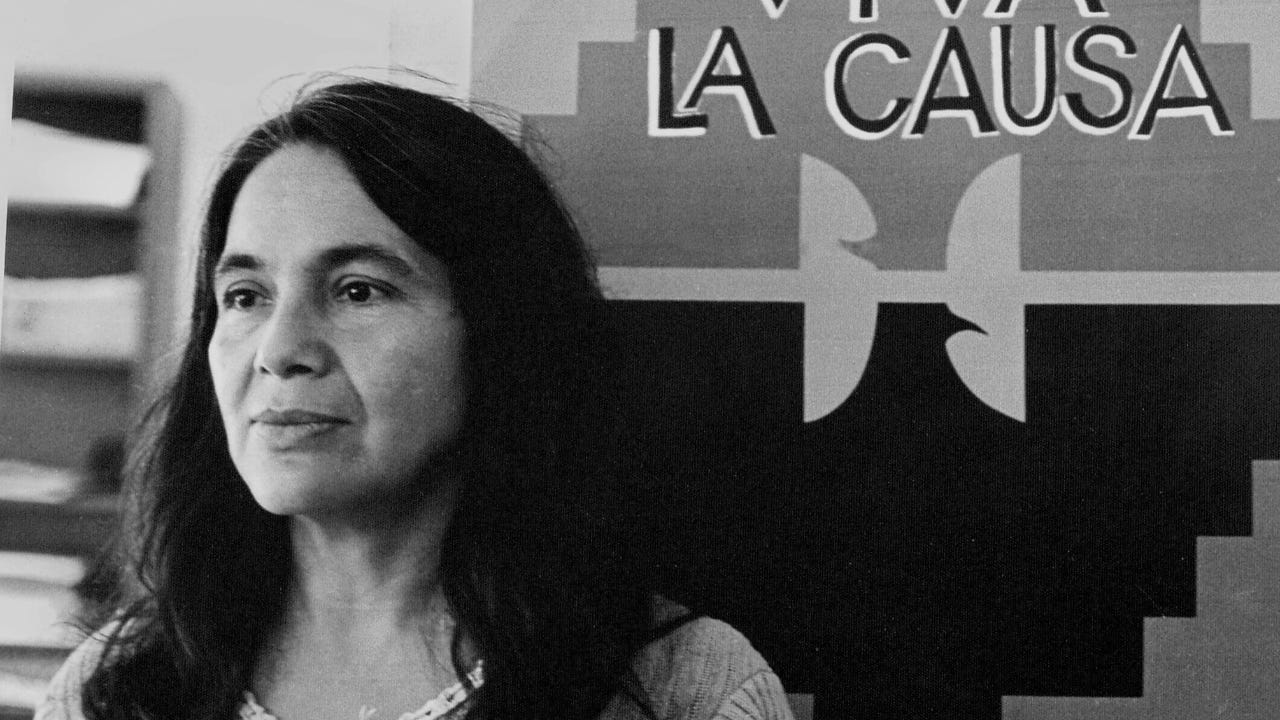
On the morning of March 18, after reading the last word of Dolores Huerta’s statement, I felt my heart break and a heavy knot form in my throat. I rushed downstairs with my phone in my hand to tell my parents. My Colombian father’s face fell into disappointment. He lowered his eyes and admitted with sadness, “Machista men have held too much power. I’m not surprised.” I got ready for work, and I couldn’t hold back the tears that fell down my cheeks behind the wheel. Why did this feel so personal?
And then it hit me: I thought she was safe. I thought Dolores Huerta had been protected, even when she was the face of a movement considered dangerous by the establishment. I naively thought that my devotion, and that of millions of Latinas who know what she sacrificed and the power of her fight, would have protected her from what we have all experienced one way or another. And I see it every day. The days go on, and more women in my life share their experiences. It happened to me when I was a young girl, and I grew up to become the friend who had already been through it, so my close friends felt comfortable enough to tell me their stories.
It is as if being subjected to sexual misconduct has become a rite of passage for young women. Worse still, as much as we speak out, the more we realize this system is not designed to defend and protect us. Yet we persist, even while we are still healing.
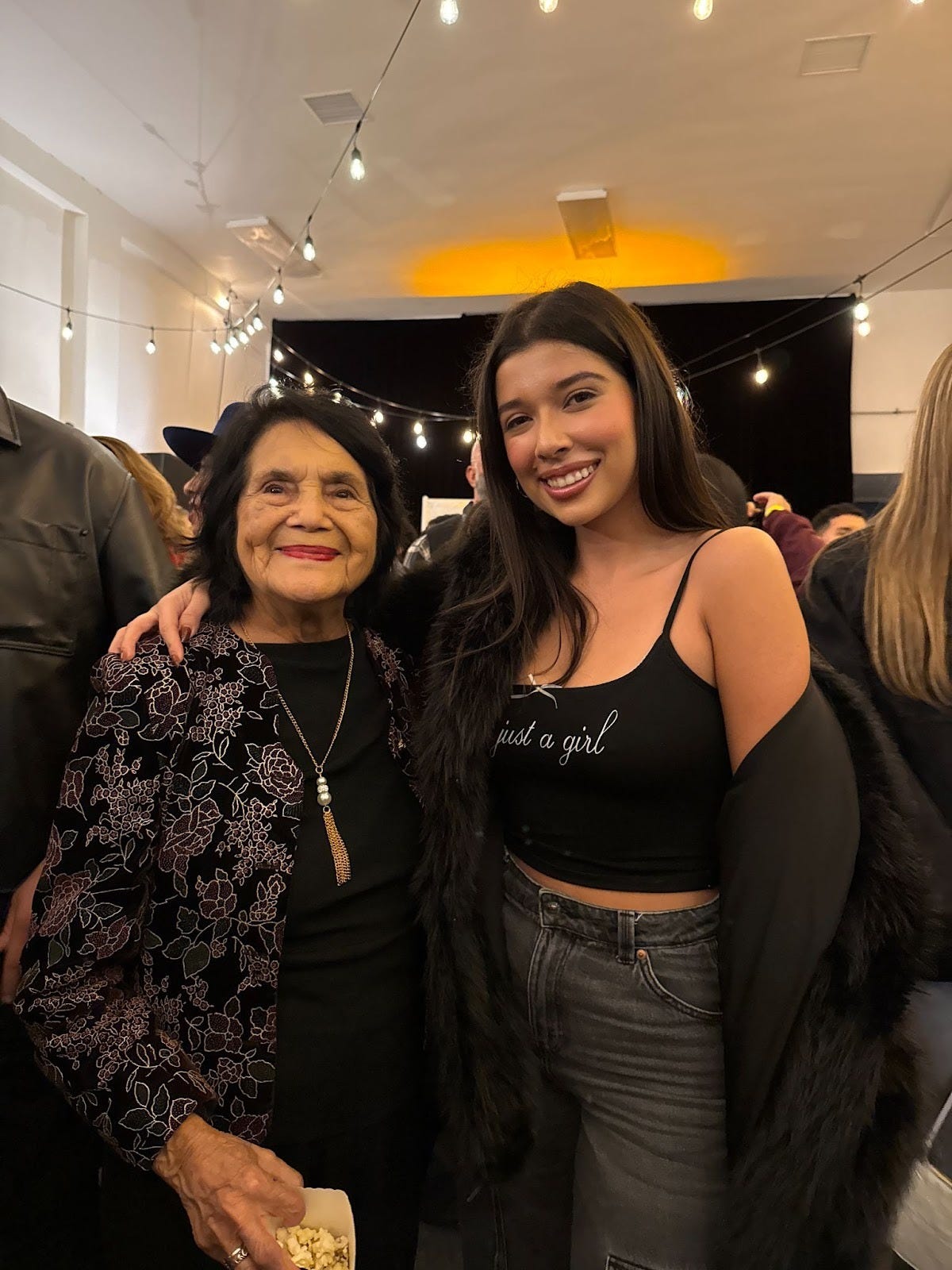
Dolores Huerta, Ana Murguia, and Debra Rojas are not victims. They are survivors, just like me, just like hundreds of millions of women. They kept their silence in the name of an entire movement, and it burdened them like stones in the pockets of a drowning man. No one should carry that weight. Not them, not the hundreds of girls trafficked by Jeffrey Epstein, not me.
The farmworker movement was pivotal for my community. It humanized us and transformed labor rights, mobilizing thousands of people who joined with other communities in civil rights efforts. It secured better pay, safer conditions, and recognition for exploited agricultural workers. It empowered Mexican Americans and Filipinos to fight against poverty, discrimination, and powerlessness. It also gave us political identity and power. It started in 1962 through the cult of personality, one in particular: César Chávez.
Chávez became a beacon of hope for millions. While the uncomfortable silences that often arose when discussing César Chávez Day were familiar to all of us, we needed that figure. We all heard about his disdain for undocumented immigrants and Filipino workers. Latino outlets would remain silent. For God’s sake, people would compare him to Martin Luther King and Gandhi. We had “one of our own,” and we were proud. Maybe not of him, but of the force of the movement he had set in motion.
Because we have always known we are more than the stereotypes and the vilification of governments and media alike. We know the value of our community, and having someone in the public sphere who was “fighting the good fight” was a life raft in an ocean of desperation.
Now, that figure has crashed at our feet, this time with horrible accounts, stomping on our hearts and forcing Dolores Huerta to say out loud the horrors she suffered in silence to protect such an important movement for our community.
“I carried this secret for as long as I did because building the movement and securing farmworker rights was my life’s work,” Huerta said in her statement.
“I wasn’t going to let Cesar or anyone else get in the way. I channeled everything I had into advocating on behalf of millions of farmworkers and others who were suffering and deserved equal rights.”
This is happening at a moment when many U.S. Latinos are so desperately grasping onto any source of home, inspiration, or haven. It is also happening at a moment when our own government is at the center of a whirlwind of sex trafficking allegations and millions of documents that are evident proof for everyone except those in power. And we are enraged. But we have a similar situation within our own community, so I wonder: is it time to face our history for its facts, not for what it could better serve in public discourse?
I can’t help but think about California’s Governor Gavin Newsom’s statement: “The farm workers movement and a labor movement are much bigger than one man — and we celebrate that, and that will be our focus as we process what the next steps are.” And that’s precisely it: it is much bigger than one man. In fact, it is much bigger than any man.
As survivors, we face the scrutiny of people in disbelief—people who are either uncomfortable with the truth or want to protect the perpetrators. More often than not, the United States court system fails to advocate for our stories. In other instances, it is even more traumatizing to proceed with a legal case and have your entire life opened up for interpretation and debate by a bunch of, again, men.
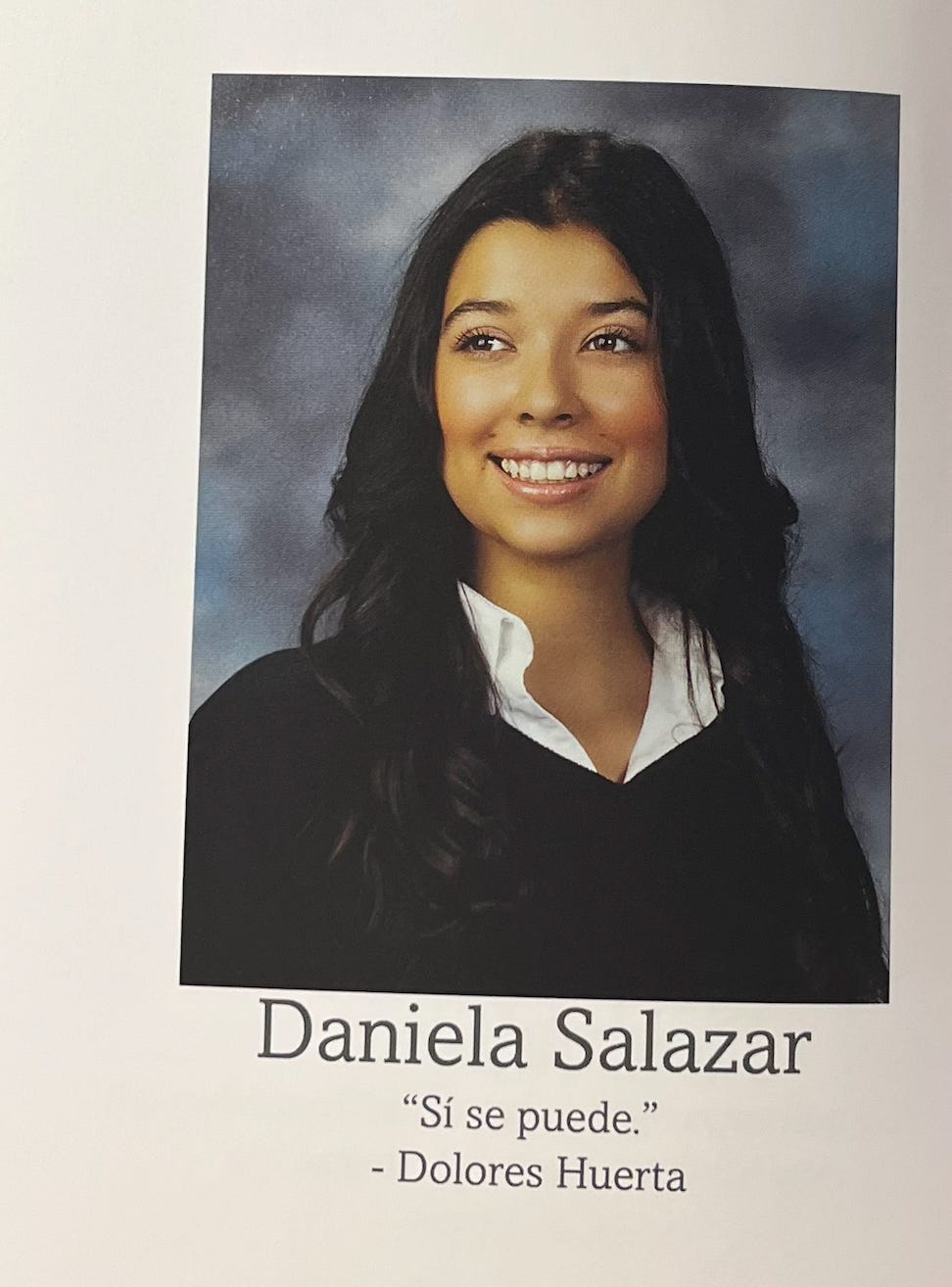
Dolores Huerta, for example, had to find out she was not the only survivor through The New York Times investigation, and that devastated her. That’s how the system works. Yet she spoke. She refused to remain “calladita,” and more than 60 years later, she still reminds us that “sí, se puede.”
 | A guest post by
|
This was such a powerful piece. It was hard to read through without feeling deeply emotional.
“As survivors, we face the scrutiny of people in disbelief—people who are either uncomfortable with the truth or want to protect the perpetrators.”
So true.
I actually wrote something recently sitting with all of this. If you ever feel open to it, I’d value your thoughts.
https://greciafigueroa.substack.com/p/dolores-huerta-and-the-price-of-silence?r=fxwzm&utm_medium=ios
Thank you. ❤️❤️❤️❤️❤️