

Op-Ed: As a Historian, These Are the Frida Kahlo Facts I Hope Netflix Doesn’t Leave Out
Guided by Rien n’est noir, the adaptation can finally choose rigor over folklore.
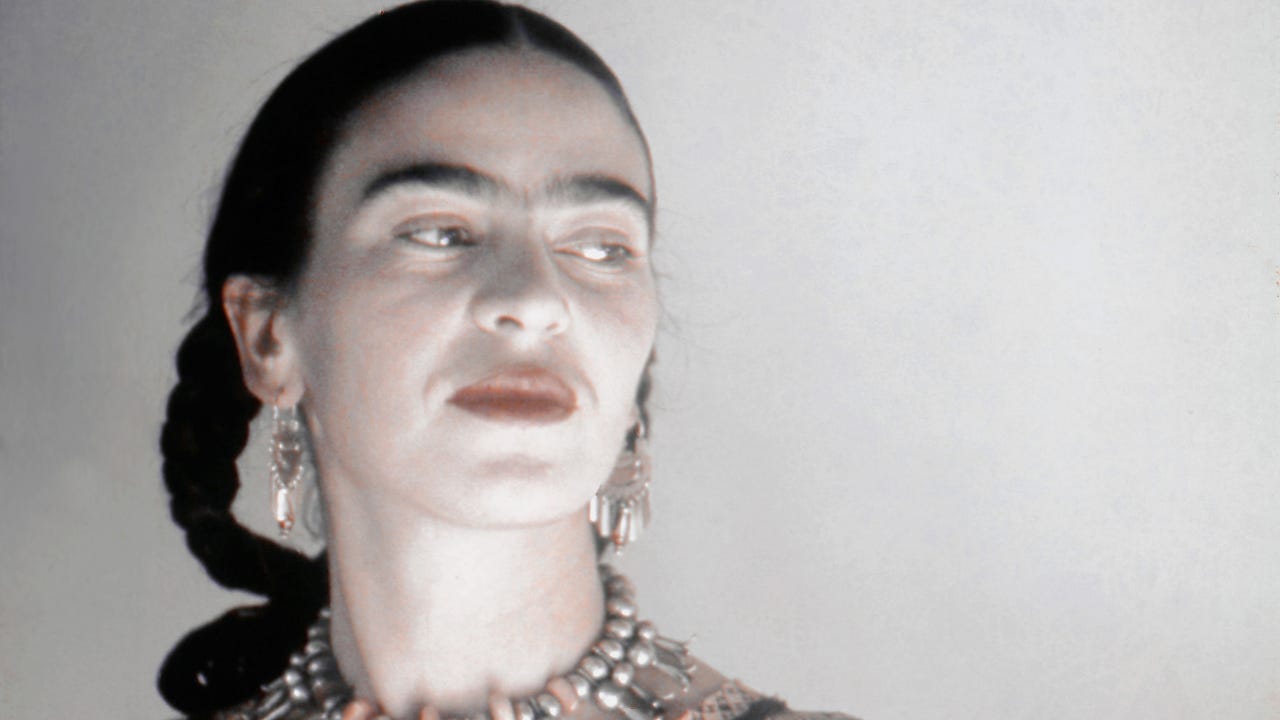
Frida Kahlo has been watched, rewritten, consumed, and explained to death. She has also been reduced, for decades, by the very people who claim to “canonize” her, often filtered through male art historians who positioned her as Diego Rivera’s companion who also happened to paint.
Time has corrected some of that. Yet it has also created a new problem: Frida as a Benjaminian object of consumption, endlessly reproduced and endlessly purchasable, a face on mass-market products. For anyone who has not read Claire Berest’s Rien n’est noir, Frida can still feel like an enigma, or a symbol, rather than a person with a historical body, a political mind, and a life shaped by events that never stop arriving.
So when I learned Berest’s book would guide the new Netflix adaptation, my expectations shifted. Berest has been one of the few who delves into the depths of Frida’s complex personality while contextualizing her within the historical moment that framed her life, even though Frida herself often lived out of sync with the era she inhabited. And when the new Netflix series is being developed by Patricia Riggen (Tom Clancy’s Jack Ryan), that detail alone raises the stakes. Riggen is one of the few directors of color in the industry and the first Latina director to helm action thrillers. If any life qualifies as an action thriller, at least emotionally, it is Frida’s relationship with pain and love.
Berest argues Frida Kahlo’s life revolved around two pivotal events: the car accident that left her with a broken spine and meeting Diego Rivera. Those events shaped everything that followed. They also risk becoming shorthand. So here is what I hope the Frida Kahlo series refuses to leave out.
The Frida Kahlo series has to start with her self-invention
Something has puzzled scholars of Frida’s life for decades: there are two versions of her birth date.
Frida said she was born on July 7, 1910, the same year the Mexican Revolution broke out. That date appears on the plaque at her famous Blue House in Coyoacán. “Frida said she was born with the Mexican Revolution. She used to take three years off her age,” explains art historian Julia Buenaventura. “It was her way of saying she was born with modern Mexico,” she explains.
According to her birth certificate, she was actually born on July 6, 1907. It was the first time Frida edited the history she wanted to live.
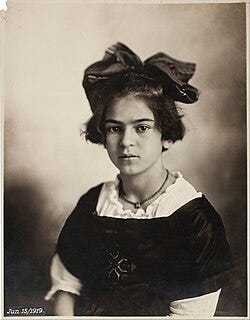
The facts that shaped the girl before the icon
Magdalena Carmen Frida Kahlo y Calderón.
Her father, Guillermo Kahlo, was German and was her first great love, while her relationship with her mother was distant. Guillermo cared for her when she contracted polio, even though he suffered from constant epileptic seizures. She did not speak German but spoke very good English from a young age.
Even her name carries a political biography. Until the late 1930s, she spelled it the German way, Frieda, derived from Frieden, the German word for peace. With the rise of Nazism in Germany, Frida stopped using the “e” in the middle of her name.
In her personal papers, she sometimes signs as Frida Kahlo, sometimes as Frida Kahlo de Rivera, sometimes as Frida Rivera, and even as Carmen Rivera.
Identity, in other words, was never stable.
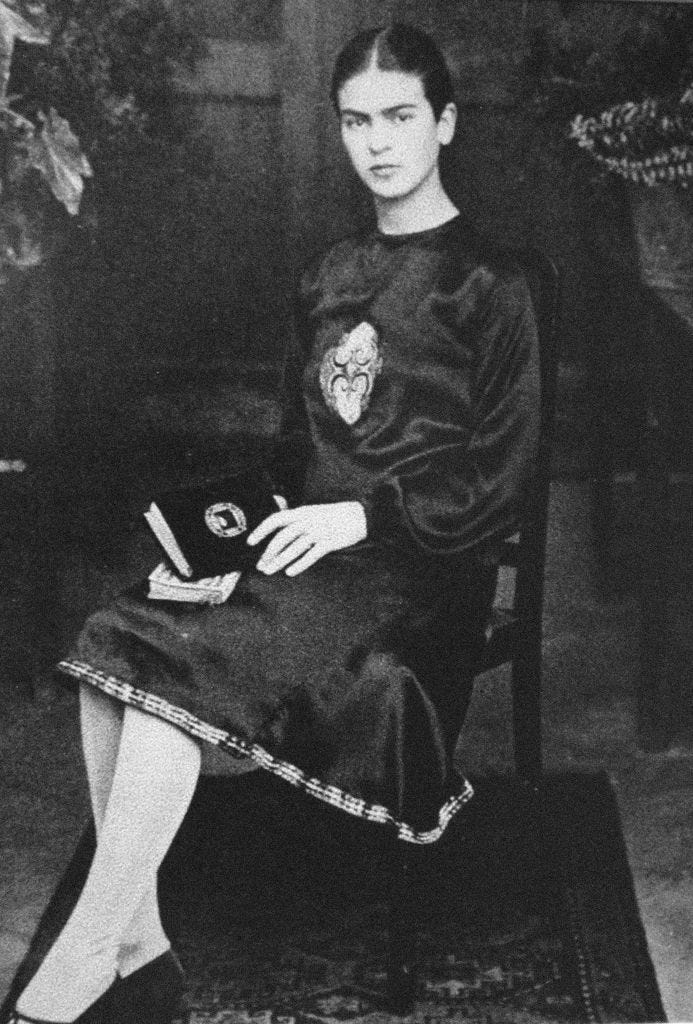
The Frida Kahlo series should show her ambition before the tragedy
She was so intelligent and daring that she was one of the first women to enroll at the National Preparatory School in Mexico City, aspiring to study medicine. At school, she met intellectuals who stimulated her ideas and her thirst for political and philosophical discussions.
While the common myth makes it sound as if painting was a romantic calling for Frida, it was not. She had a plan, but so did life.
Frida did not always dress like “Frida”
For many, the image of Frida is associated with her Tehuana outfits made of colorful fabrics, traditional to the Oaxaca region. But the artist did not always dress that way.
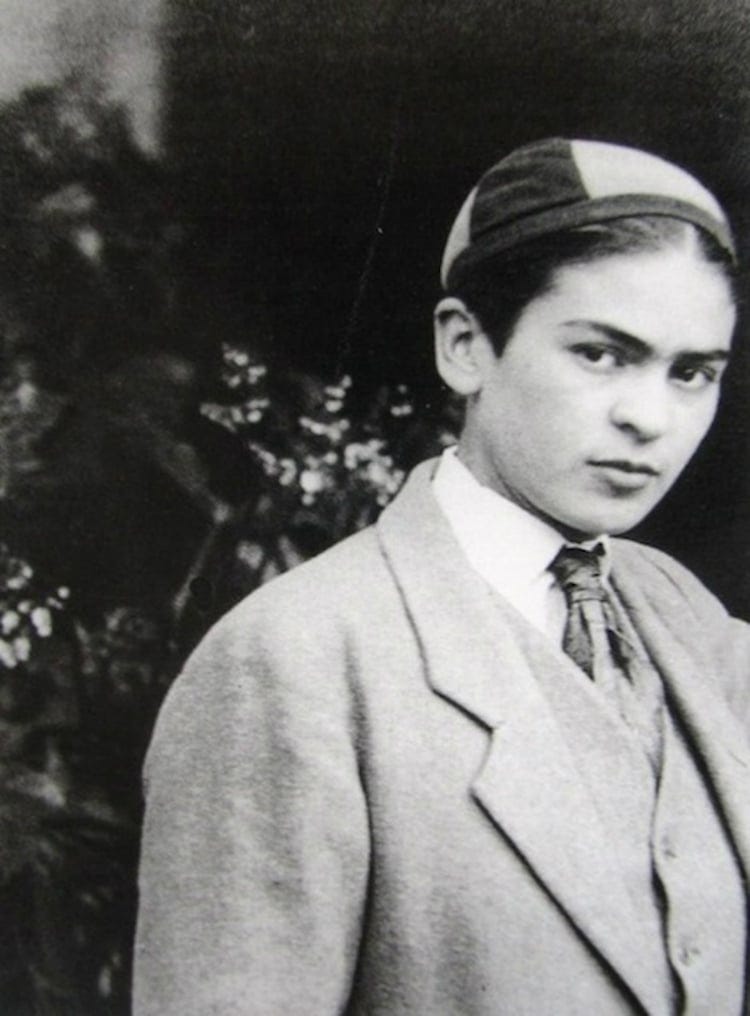
Historian Julia Buenaventura notes that, as seen in one of her 1926 self-portraits, where she wears a red velvet dress, the young Frida dressed in the French style, like the women of her time and class. There are also several photos showing her dressed in men’s suits during her youth.
Guadalupe Rivera, who was Diego’s wife when Frida met him, described her as a “flapper,” the term used for the modern women of the 1920s who wore short dresses and corsets.
The Tehuana dress came into fashion after the Revolution. It is a symbol of Mexican identity. “Wearing Tehuana dresses was part of Frida’s self-creation as a legendary figure,” wrote Hayden Herrera in her biography of the artist.
One of Kahlo’s paintings, “There My Dress Hangs,” depicts precisely one of her Tehuana dresses against the chaotic backdrop of Manhattan. “The Two Fridas” also uses the Tehuana dress to represent the intensely Mexican Frida she became, in contrast to the Frida with European roots from before she met Diego.
The first accident has to feel as deep as her broken bones
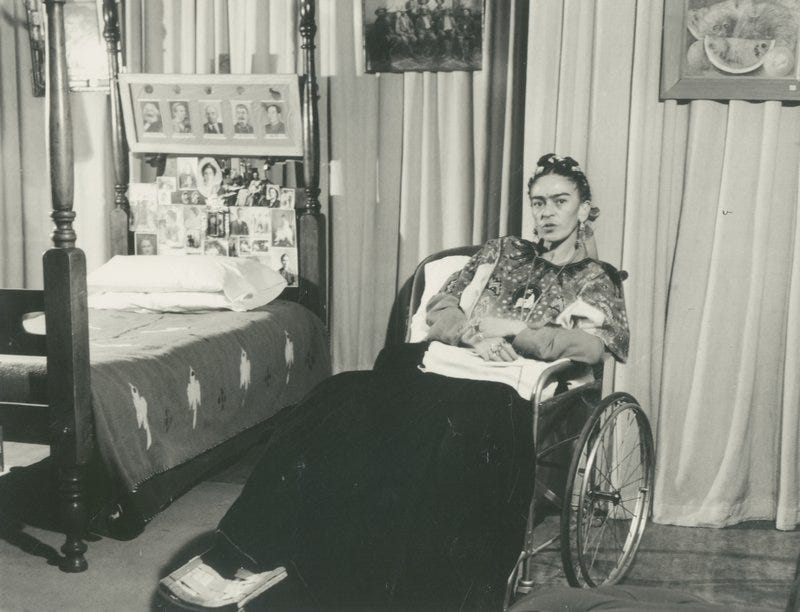
On September 17, 1925, Frida suffered a devastating crash on her way home from school. The bus she was riding in collided with a streetcar, and the impact wrecked it. She was with Alejandro Gómez Arias, her boyfriend at the time. The injuries were catastrophic: her spine was fractured in three places, she broke two ribs and her collarbone, and she fractured three pelvic bones. Her right leg was shattered in eleven places, and her right foot was dislocated.
Regarding this, Kahlo remarked that this must have been the brutal way in which she had lost her virginity.
The medical practices of her time subjected her to multiple surgical operations, at least 32 throughout her life, plaster and various types of corsets, as well as various stretching devices.
Shortly before, she had begun working as an apprentice in Fernando Fernández Domínguez’s engraving and printing workshop. Before her accident, she had shown no particular interest in painting. Nor did she follow the art class at school with much interest. The battle against the aftereffects of polio led her to lean toward sports activities. However, after the accident, she tried to move as little as possible to aid healing. Thus, painting took center stage in her life.
Early paintings, early circles, and the road to Diego
In 1927, she painted the Portrait of Miguel N. Lira, an oil on canvas measuring 99.2 x 67.5 cm, in which she depicts her partner wearing a cap against a distinctive, symbolic background filled with objects and symbols alluding to his name. A year later, she painted a portrait of her sister Cristina with very clean lines and soft tones.
By this time, Frida had already begun to frequent political, artistic, and intellectual circles. Through Germán de Campo, a student leader whom Frida greatly admired, she met the Cuban communist Julio Antonio Mella, who lived in exile in Mexico with his Italian partner, the photographer Tina Modotti. Through them, Frida came into contact with the painter Diego Rivera, 21 years her senior, with whom she would begin a relationship.
Ergo, she was already a painter and a complete individual before meeting Diego.
Diego as a footnote
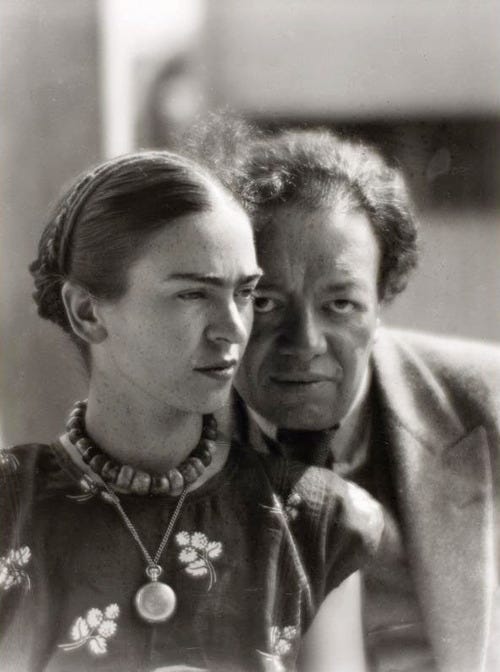
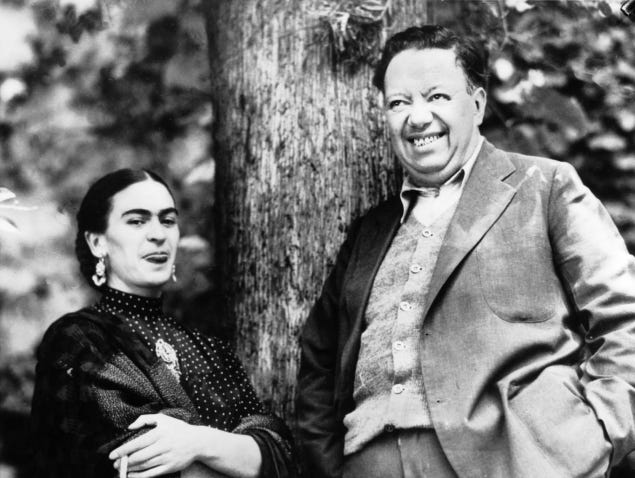
Many know about Frida and Diego’s love story. However, few people know she was 15, and he was 36 when they met in 1928 at the National Preparatory School, where Diego painted a mural. Two years later, they married for the first time, and love put Frida’s tenacity to the test. “It’s a marriage between an elephant and a dove,” Frida wrote, recalling what her mother told her upon hearing the news.
We all know the story of Diego’s affair with Frida’s half-sister. Fewer know of Frida’s affair with the exiled Russian politician Leon Trotsky.
Both Frida and Diego were members of the Mexican Communist Party, although Diego was expelled. Both declared themselves Trotskyists until the start of World War II.
The relationship was tumultuous because of their personalities. It was also due to the circumstances.
Pregnancy, Detroit, and the paintings that changed art history
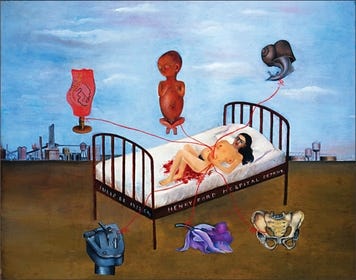
A year after their marriage, Frida became pregnant for the first time, but her body could not carry the pregnancy to term, and it had to be terminated.
In 1932, Diego Rivera was commissioned to create the Detroit Industry Murals for the Detroit Institute of Arts. In April, Frida painted “Sideboard on a Detroit Street,” heavily influenced by Giorgio de Chirico. She became critical of the American way of life, and this reflected in her paintings from that period. However, they were living in the U.S., not just visiting.
In August, she witnessed a solar eclipse, prompting her to incorporate the duality of night and day into some of her paintings, which became a recurring iconographic element in her work.
While in Detroit, she suffered a second miscarriage. During her recovery, she painted her self-portrait, Abortion in Detroit, executed in a more penetrating style, inspired by the small votive paintings of Mexican folk art known as retablos. What few people know is that, just as today, abortion was taboo, yet Frida spoke loudly about it, and about the pain behind.
Surrealism, refusal, and Frida’s own sentence
In 1938, the Surrealist poet and essayist André Breton described her work as Surrealist in an essay he wrote for her exhibition at the Julien Levy Gallery in New York. However, she later stated: “They thought I was a Surrealist, but I wasn’t. I never painted my dreams. I painted my own reality.”
However, few women were allowed to be part of the “boys club” in art history, no matter the genre or period. Women were often sidelined. Yet, Frida made it without even asking for it.
Politics as plot
In 1937, she and Diego met Leon Trotsky, an exiled Soviet revolutionary, and offered their home in Coyoacán for him to live there with his wife. Soon after, Frida began a brief affair with him.
Around this time, Diego Rivera adopted Trotskyist ideology. Within the Single Union of Construction Workers of Mexico City, the union led by Juan R. de la Cruz, whom Fernández Vilchis had trained and politically educated, discussions began regarding joining a faction of the Fourth International.
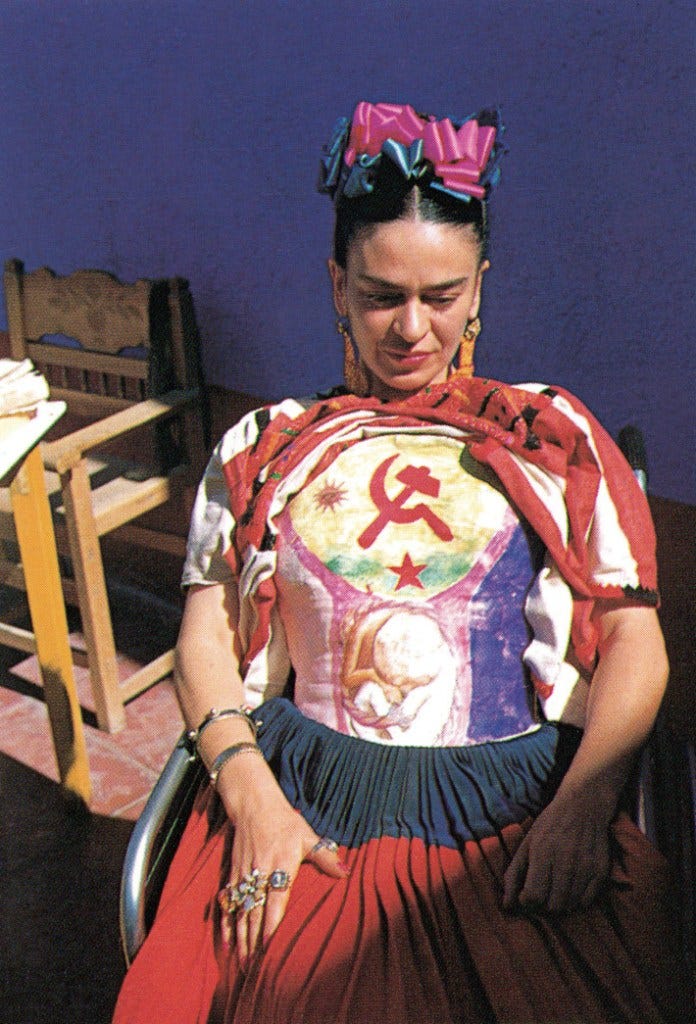
Faced with discord among the members, and because the movement was being sacrificed to Trotsky’s personal interests, Diego Rivera deemed it necessary to dissolve this Mexican section. Subsequently, Kahlo and Rivera changed their political views, becoming Stalinists, which caused a rift between them and Trotsky.
Nevertheless, Trotsky tried to rekindle his relationship with Frida, writing to her to ask her not to abandon him, but she never replied.
The divorce, the self-portraits, and the interior war
In 1939, Kahlo completed The Two Fridas, a self-portrait that reflected her two personalities. In this painting, she processed her marital crisis through the separation between the Frida in the Tehuana costume, Diego’s favorite, and the other Frida, of European roots, who existed before she met him. A vein connects the hearts of the two women. The rejected European part of Frida Kahlo threatens to bleed her dry.
After enduring a dysfunctional marriage marked by emotional abuse and infidelities on both sides, Rivera filed for divorce on November 6, 1939. Frida temporarily returned to her home in Coyoacán, where she suffered a period of depression during which she turned to alcohol as “a way to alleviate her physical and psychological suffering.” Their divorce was finalized in January 1940.
Trotsky’s assassination, her detention, and the remarriage contract
On May 24, 1940, David Alfaro Siqueiros attempted to assassinate Leon Trotsky, who was still residing at Frida’s home in Coyoacán. Following this attack, a raid was conducted at the residence, and the police detained her for several hours.
On August 21, Trotsky was assassinated at the age of 60, leading to accusations that she and Diego Rivera had killed him due to their close relationship with him. Both were arrested but were eventually released.
Unable to bear being apart from one another, they decided to remarry on December 8 of that same year. However, it was under certain conditions: Frida demanded financial independence and shared expenses. Many speculate that Frida refused to have sex with Diego, but there is no evidence to support this.
Teaching, recognition, and the U.S. institutions that framed her late career
Starting in 1943, she began teaching at La Esmeralda School in Mexico City.
In the late 1940s, her artistic work received increasing recognition, especially in the United States. She participated in major group exhibitions at the Museum of Modern Art in New York, the Institute of Contemporary Art in Boston, and the Philadelphia Museum of Art. She also took part in The Exhibition by 31 Women, organized by the patron and collector Peggy Guggenheim.
Death, the missing autopsy, and the Communist flag
No autopsy followed her death, and that absence left room for a competing version of events: that she took her own life. The basis for that account, as it has circulated, comes from her nurse, who said she monitored Kahlo’s painkillers and claimed that on the night before she died, Kahlo overdosed. The nurse’s version hinges on a specific detail: Kahlo had been prescribed a maximum of seven pills, but she took eleven. That same night, she also gave Rivera a wedding anniversary gift more than a month early.
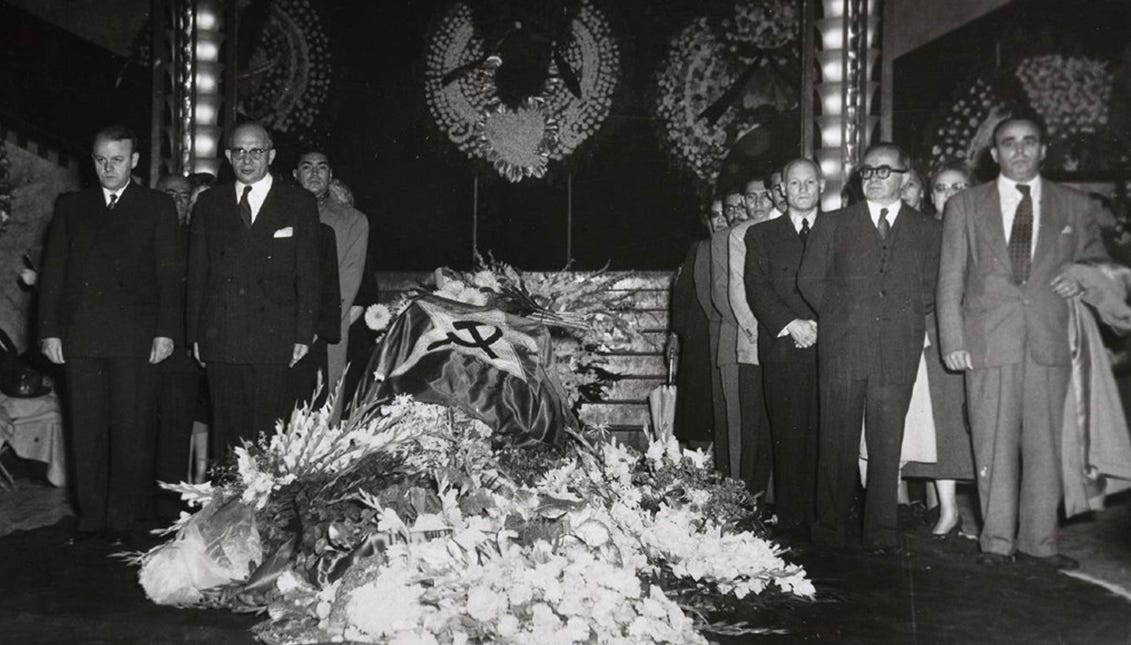
Afterward, her body was laid in state at the Palacio de Bellas Artes. Her coffin was draped with the flag of the Mexican Communist Party, a decision that drew heavy criticism from the national press. Following the funeral ceremonies, she was cremated at the Panteón Civil de Dolores, and her ashes were returned to the Casa Azul in Coyoacán, where she was born and which later became a museum.
Rivera later called her death “the most tragic day of his life.” He died three years later, in 1957.