

Of Course the Girl Grip Went Viral
It started as a TikTok about carrying your phone and your lip balm in one hand. But it's also the most honest portrait of womanhood.
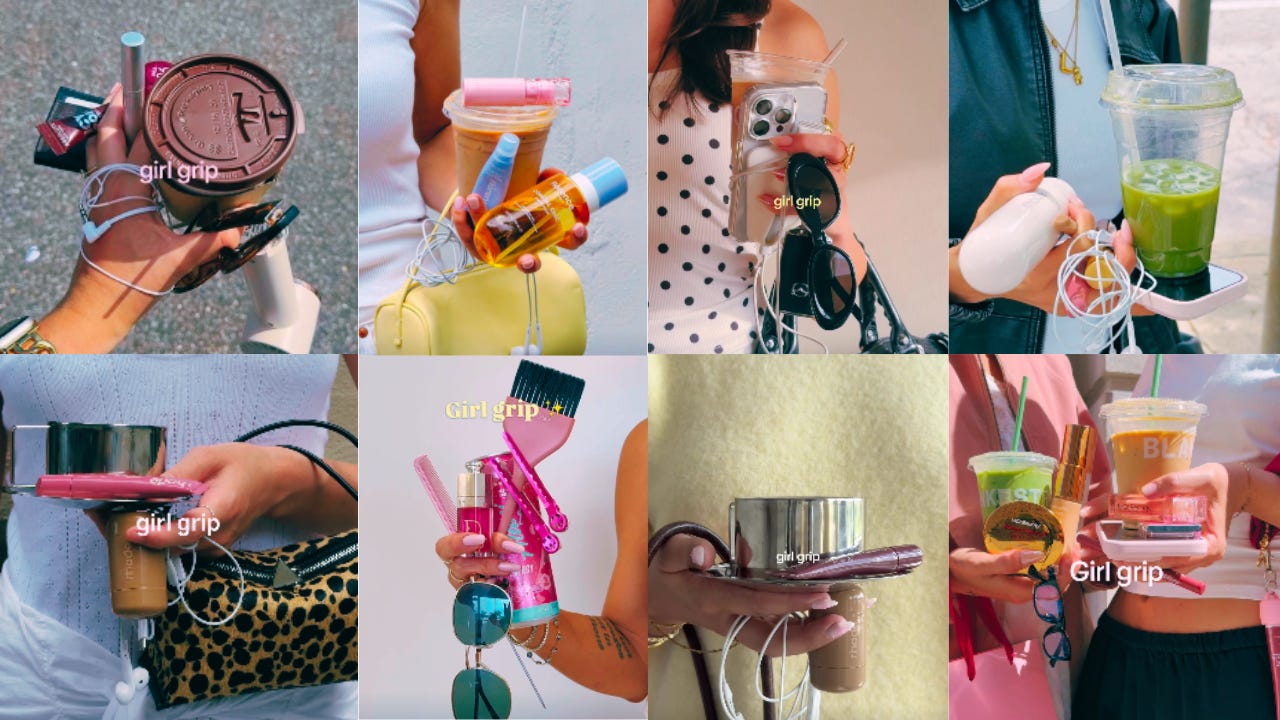
The iced coffee goes between the ring finger and the pinky. The phone sits flat against the palm. The keys dangle from the index finger, the sunglasses fold over the thumb, and the lip balm wedges in wherever it fits. No bag. No second hand. Just one woman holding an entire night out in one fist, without dropping a thing.
That is the girl grip, and if you have been anywhere near TikTok or Instagram lately, you have seen it. Gen Z women are posting videos of themselves carrying a full night’s worth of essentials in one hand: a fan, a vape, sunglasses, lip balm, a phone, and, for those who are really showing off, a drink, too. The Instagram account @girlscarryingshit, followed by 449,000 people, exists entirely to celebrate the practice. Its bio reads: “After thousands of years w/o pockets, non-men have evolved a superior grip to carry our sh*t.” One post, liked by 2,000 users, shows a woman holding an iced coffee, a bottle of aloe vera, and an entire bottle of wine in a single hand.
And the “non-men” conditional is scientifically accurate. In fact, TikTok user Brooklyn and Bailey asked men to replicate it, and they simply couldn’t.
Did Gen Z Kill the Handbag?
Beyond a superhuman skill, the girl grip is also a not-so-silent rejection. According to research by the wine brand Echo Falls, almost a third of Gen Z women now go out without a handbag. Thirty-four percent said ditching one makes them feel freer. Forty-four percent consider handbags old-fashioned. On the other hand, 45% of Gen Xers and baby boomers still refuse to leave home without one, and 60% use theirs to carry everything. Millennials are still the middle child, sometimes choosing their fav tote or simply going full grip. But for Gen Z, the bag is cumbersome, crashes into people on a crowded dance floor, and is one more thing to worry about all night.
And the market is paying attention. Luxury bag sales are down almost 10 percent from their 2023 peaks, according to data from Bain & Company, a roughly $8 billion drop in annual spending. For their part, brands pivoted almost immediately. Lacoste, for example, posted a TikTok captioned “the power of a girl grip” showing a woman balancing a Lacoste wallet, a croissant, sunglasses, keys, earphones, and a can of matcha in one hand. Millie Bobby Brown’s Florence By Mills, Rihanna’s Fenty Beauty, and Jennifer Lopez’s J Lo Beauty have all made versions of the video, staging their products alongside iced coffees and earphones in the open palms of women who do not need a bag to hold it together. As The Times noted, the girl grip has become its own form of peacocking: instead of hiding your essentials in a bag, you display them.
Not Every Girl Grip Looks the Same
While brands tend to envision the grip a certain way (think a Laneige lip balm, a Susmies fan from Barcelona, a pair of Prada sunglasses), the girl grip adapts to whatever the woman is actually carrying.
The Facebook account The More Than Project, for example, posted a reel highlighting what the grip looks like for caregiver parents when essentials aren’t a designer wallet and an expensive coffee, but paperwork, medications, a medical bracelet, sensory headphones, earbuds, a water bottle, keys, a tablet, a caffeine packet. “Somewhere along the way, you start carrying everyone else’s needs alongside your own,” the caption reads. “It’s not glamorous, but it’s a pretty accurate picture of what caregiving looks like.”
Beyond The Trend, The Girl Grip Is the Mental Load Made Visible
Writing in Social Ketchup, Smrithi Mohan argued that the girl grip points to something that goes beyond coordination. Women have spent generations adapting to systems, products, and spaces built around someone else’s needs, from the long-running joke about pockets, or rather the absence of them, to the expectation of always being prepared, organized, and accommodating.
The grip, Mohan writes, mirrors all the tabs that are constantly open in a woman’s mind: remembering a friend’s birthday while planning tomorrow’s meetings, wondering if a parent has taken their medication, mentally drafting a text a friend needs to send, replaying a conversation from three days ago wondering what went wrong, keeping track of a to-do list that no one else chooses to see.
The same women who balance six objects in one hand often balance an invisible weight that goes entirely unnoticed. Family expectations, a partner’s emotional needs, workplace responsibilities, social pressures. And, of course, safety concerns. Their own ambitions often fall somewhere at the bottom of the pile.
This hits close to home for women of color. We carry our own responsibilities and the constant mental exhaustion that comes with taking care of households, friendships, and communities, all while being expected to look good and not complain. The girl grip, Mohan argues, is where our hands have started mirroring our minds, both finding a way to hold far more than they were ever meant to.