

Meet Liliana Villarreal, the Latina Who Brought Artemis II Safely Back to Earth
Born in Cartagena and trained in the United States, she ran the mission’s most unforgiving minutes: reentry, splashdown, and extraction.
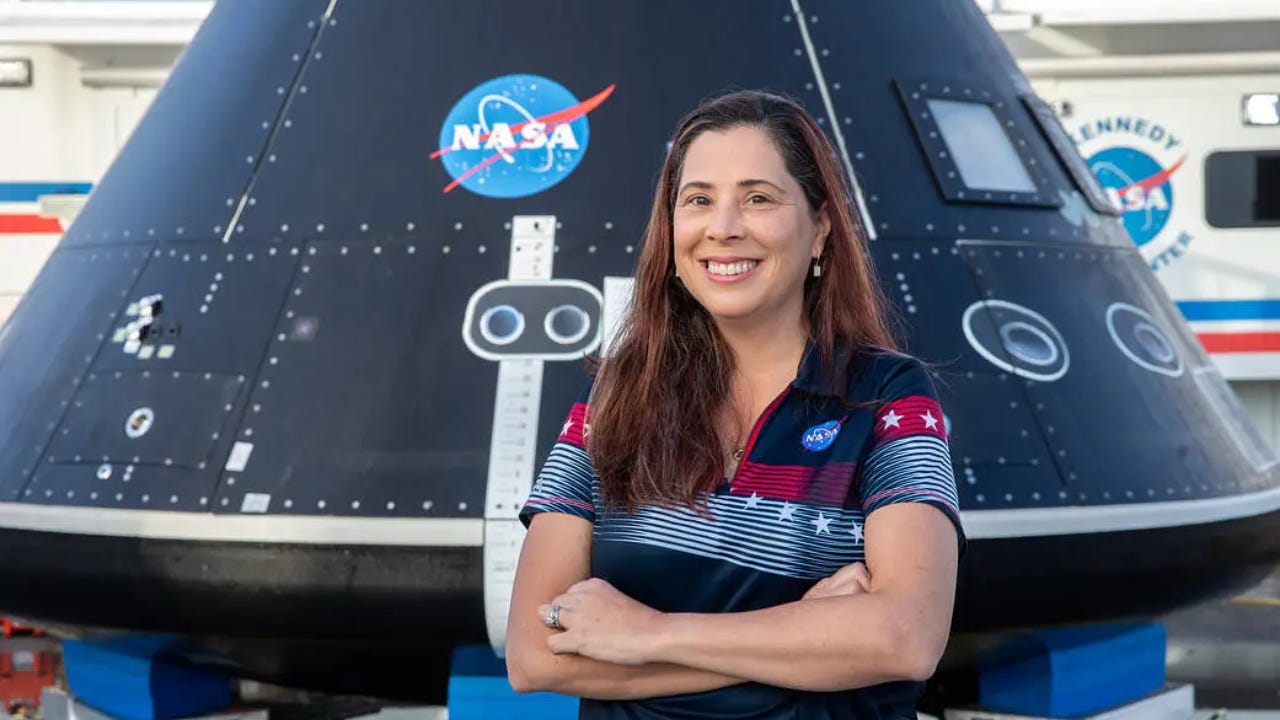
Some accomplishments end with fireworks. Artemis II ended with water.
After 10 days around lunar orbit, after the spacecraft looped past the far side of the Moon, after the world watched the spectacle of “humans returning,” the mission still had to do the hardest thing: come home safely. And the person leading that final act was Liliana Villarreal, an aerospace engineer born in Cartagena who now holds one of NASA’s most demanding jobs: Landing and Recovery director for Artemis II.
Liliana Villarreal held the job where “success” becomes a matter of life or death
Liliana Villarreal directed the landing and recovery of NASA’s Artemis II mission, which successfully splashed down on April 10, 2026, carrying four astronauts who had traveled around the Moon after passing the far side. The Artemis program’s stated goal was to return humans to the Moon after more than half a century.
Villarreal, then, was the official who “detailed the rigorous protocol” designed to guarantee the crew’s safety during the return and recovery in the Pacific Ocean.
The Artemis II return was built around terrifying numbers
The return of Artemis II was scheduled for April 10 at 8:07 p.m. EDT. Per information shared by NASA through its official channels, the spacecraft would enter the atmosphere at speeds of up to 25,000 miles per hour, and the vehicle’s job was to protect the crew while it drastically reduced speed.
NASA used a complex system of 11 parachutes—decelerators that slow down falling objects—activated one after another, to reduce the capsule’s speed to about 20 mph at splashdown, when the spacecraft lands in the ocean. The splashdown would take place roughly 60 miles off the U.S. coast, marking the end of Artemis II’s spaceflight.
Liliana Villarreal was coordinating every second of that return. She called it the “segment of greatest critical risk,” noting that an error during reentry or ocean contact could compromise the crew.
Liliana Villarreal described the hardest part with unflinching clarity
El Tiempo quoted Villarreal describing the wait for splashdown as the most demanding moment for her recovery team: “The moment that could be the most challenging of the mission for us is waiting for the splashdown after the vehicle enters the atmosphere.”
For that crucial moment, Villarreal and her team relied on decades of preparation, developing ground support equipment, operational frameworks, and procedures to ensure success.
The ocean rescue plan had to work like a clock
Once Orion hit the water and conditions were confirmed to be safe, Navy divers and NASA open-water experts began a coordinated recovery.
Villarreal explained the next step: “When the four crew members are out of the capsule, the front porch [is] repositioned to allow the astronauts to be lifted individually into a helicopter.”
After that, the recovery has two parallel goals: care for the people and secure the spacecraft. Once on the ship, astronauts go to a medical care compartment for a post-mission evaluation before being flown by helicopter either back to the coast or to Johnson Space Center.
After the crew exited, Villarreal’s team prepared Orion for towing to the ship’s well deck, ending when the capsule was secured for transport and analysis under her supervision.
Liliana Villarreal’s NASA story is one for the books
When Liliana Villarreal was 7 years old, her family took her to the Kennedy Space Center Visitor Complex in Florida. There, she first heard the story of Apollo and the astronauts who reached the Moon. According to Pluralidad Z, this visit led her toward science, technology, engineering, and math.
Villarreal grew up in Miami after moving there with her family at age 10, attended public school, and earned a bachelor’s (1996) and a master’s (1997) in aerospace engineering from the Georgia Institute of Technology. She later earned a master’s in technology management (2002) from the University of Miami’s engineering school.
A painful rejection leads to the right pivot
After dreaming of flying to the stars, Liliana Villarreal was not selected among more than 100,000 applicants who tried to become an astronaut. However, that did not stop her.
Instead, she worked at Boeing, linked to Kennedy Space Center, participated in the construction of the International Space Station and Space Shuttle, and later joined the assembly of Orion, the capsule that would carry astronauts back to the Moon.
Liliana Villarreal’s work sits inside Exploration Ground Systems
Liliana Villarreal’s role within NASA’s Exploration Ground Systems program is arguably more crucial than traveling around the dark side of the Moon. She is responsible for managing, planning, coordinating, and carrying out the operational activities both on the ground and during flight that are needed to support missions with astronauts aboard NASA’s Space Launch System (SLS)—a rocket designed to send spacecraft beyond Earth’s orbit—and the Orion spacecraft, which carries the crew.
“The fact that this is the foundation to return to the Moon and eventually go deeper into space is an enormous inspiration for me,” she said.
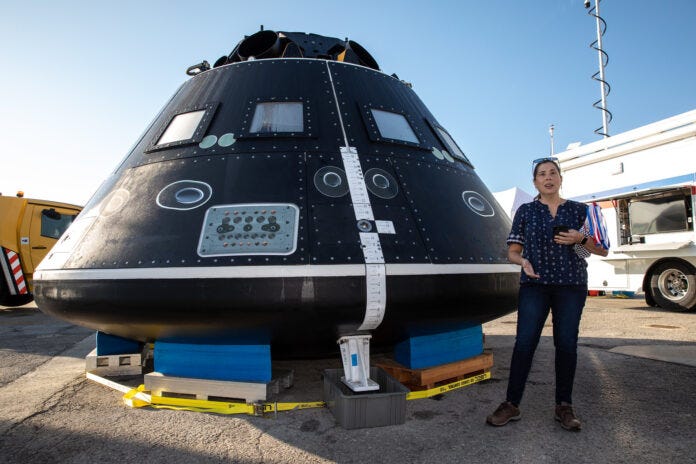
“Sí, we belong here” is a workforce reality inside NASA
As a Latina in an industry that still has work to do regarding representation, Villarreal has spoken about what she considers relevant inside the agency: the presence of Hispanic workers.
She said, “We are very fortunate at NASA to have a healthy and strong Hispanic workforce,” and she added that many of that group actively mentor younger generations and do outreach with elementary and high school students.
In fact, Villarreal is part of a group of Colombians holding key roles in Artemis II across flight direction, capsule recovery, propulsion analysis, and innovation.
For her, showing Hispanics and other minorities working in complex programs is not just messaging. It is a practical demonstration that a diverse team is a successful team.
What she said right after splashdown says everything about leadership
Villarreal’s reaction after Orion made contact with the ocean was an overwhelming combination of relief, pride, and realism all at once.
She said, “I feel euphoric and relieved. We still have to bring the capsule to the crew dock and to the infirmary, but our team has been preparing and working very hard; I’m very proud of all of them.”
Furthermore, she highlighted coordination with Mission Control in Houston, calling communication during the process a determining factor for the landing’s success.
Then she gave people the details they always want after a mission: what did the astronauts look like?
“We had video of them from inside the Orion vehicle,” she said. “From the beginning, when we opened the hatch, they were already out of their seats, having a good time. In the medical evaluation, they were all very well; they were even using their phones, probably talking about what they saw. There were smiles everywhere.”
Liliana Villarreal keeps her timeline tied to another woman
Villarreal is married to retired physician Timothy O’Hare and has two children, Sabrina and Miguel, both of whom are professionals. When asked about her future at NASA, she gave a concrete answer: she plans to retire when the first woman reaches the Moon, which will happen with Artemis III. Until then, she remains part of the team, making that possible.