

Juana La Mexicana
This is an excerpt from Reyna Grande's upcoming essay collection, MIGRANT HEART (on sale now).
By Reyna Grande.
Reyna is an award-winning Mexican-American author best known for her landmark memoirs The Distance Between Us and A Dream Called Home. This time, she turns her gaze inward to explore the scars left by migration and the ongoing work of stitching herself back together. MIGRANT HEART interrogates how living between two nations, two languages, and two identities has shaped Reyna as a woman, mother, and writer. Moving from the legacy of violence in her hometown of Iguala, Mexico, to a bittersweet family vacation in Europe spent reconciling her own impoverished past with her children’s world of abundance, she uncovers startling truths about the nature of survival. It is an essential read for the seekers, the dreamers, and anyone who believes in the enduring, transformative power of finding one’s voice.
Two years after my father left for the US, my mother followed him north, leaving her three children in Mexico. I was four years old when she immigrated to California. In January 1980, a few weeks before her thirtieth birthday, my mother arrived in Los Angeles and found a job trimming threads off freshly sewn garments in LA’s Fashion District. She was one of the thousands of undocumented immigrant women working long hours for less than minimum wage, in unsafe conditions, and with no health insurance. She made fifteen cents per piece, the threads she snipped clinging to her clothes like spiderwebs. All day she stood, with scissors in hand, in an airless room full of industrial-sized sewing machines and steam presses, rushing from one garment to the next, trying not to cut her own fingers. She hated this job. She felt trapped in this LA sweatshop.
In Mexico, she’d been an Avon lady and loved la chamba, the hustle of working in sales as an entrepreneur. She enjoyed walking from house to house around the neighborhood, displaying her merchandise and catalogs, chatting with her clients. In Los Angeles, she missed the freedom of working outdoors, setting her own hours, being her own boss. Two years after she arrived, she and my father split up. My siblings and I were still waiting in Mexico to be reunited with them. When we finally crossed the border three years later to begin our new life in Los Angeles, the family we had known in Mexico was gone. My father had left my mother for another woman, and my mother, in turn, left her children for another man. She gave my father sole physical and legal custody of my two older siblings and me, keeping only the youngest, my sister Betty, who was born in the US. We never shared the same address again. I saw my mother only once or twice a month. Stepping back from our lives, she allowed my father and stepmother to raise us as they saw fit.
My siblings and I grew up in Highland Park in northeast LA, which at that time was a working-class Latino neighborhood with a serious gang problem. But we came from the poverty-stricken state of Guerrero—the second-poorest state in Mexico—so Highland Park was a huge upgrade. The dirt roads of my childhood were replaced by wide, paved streets that seemed to go on forever. Instead of shacks made of sticks and cardboard, like the one we called home in Mexico, the streets were lined with real houses made of thick stucco walls and shingled roofs. Although we were still poor by American standards—my siblings and I slept in the living room on a sofa bed, our sleep punctuated by gunshots, sirens, and the whirring of police helicopters in the distance—the solid walls of our one-bedroom duplex on Avenue 50 provided a protection we’d never known in Mexico.
My father, a maintenance worker with a third-grade education, spoke little English. We were still undocumented then, but he’d hold up our report cards and say, “I brought you here to this country so you could get an education, have careers one day, be homeowners, have money for retirement.” These were his hopes, and he demanded excellent grades and perfect attendance, threatening to send us back to Mexico otherwise. He wanted us to achieve the American Dream in all its glory and for our lives to be completely different from those we’d left behind. “We are in California now,” he’d say, “and we need to look forward, not back.”
My mother was the opposite of my father. She had humble aspirations, not lofty dreams. She was content with what little she had, as no poverty in Los Angeles could ever compare to the poverty she’d left behind. “Sometimes, we had nothing to eat but a tortilla sprinkled with salt and a jalapeño pepper to warm our bellies,” she’d say. As long as she wasn’t that poor, she was happy. For her, survival was enough. She’d never been taught to reach for more. Where did my father get his ambition? Who taught him to dream bigger? I do not know. What I do know is that he passed it on to his children. “I didn’t bring you here to be nobodies,” he often said. “We didn’t risk our lives crossing the border for you to end up as failures.”
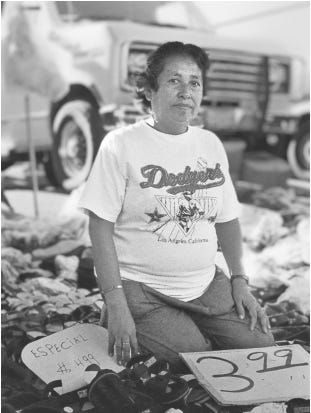
A few years later, my mother left her factory job to become her own boss—a vendor at local open-air swap meets, like the tianguis in Mexico. Because she didn’t drive, her husband quit his ironing job, and they both worked the swap meets: in South El Monte on weekends, in San Fernando on Tuesdays, in Santa Fe Springs on Wednesdays and Fridays. Thursdays, they restocked merchandise at the wholesale shops in Downtown LA. They traded their stable, if low-paying, jobs in the garment industry for the risky business of selling Avon, Jafra, and Mary Kay products, as well as seasonal items like silk roses and teddy bears for Valentine’s Day, cheap plastic sandals in the summer, and toys at Christmastime. “Look at your mother,” my father would say with a grimace. “That’s no way to live. Peddling goods at the swap meet. No stability, no retirement, no benefits. That’s why she’s on welfare.” The more he denigrated her, the more we did, too. We worked harder at school, vowing not to follow her path. We were determined to be different, to achieve the life our father craved.
My father’s dreams, while well-intentioned, burdened his children immensely. I carried the weight of his expectations, pressured to succeed and validate his sacrifices. But the more I tried to live up to them, the more distant I grew from him and from my mother. When our mother’s (and little sister’s) absence overwhelmed us, my siblings and I would go see her. We entered another world when we visited her in Downtown LA. My mother’s neighborhood near Skid Row made us wonder if we were still in California, and not in a poverty-stricken country like the one we’d left. Walking from the bus stop on Spring Street to her house on San Pedro Street, my sister, brother, and I navigated through the unhoused people spread out on the sidewalks and avoided the sex workers standing on corners. The streets reeked of urine and marijuana. Piles of trash crunched under our feet. Plastic bags of all colors floated around us in the wind like miniature parachutes. We hurried to our mother’s one-room studio, squeezing amid the chaotic jumble of furniture and stacks of boxes where she stored her belongings. Her home, with a shared bathroom and kitchen on that floor, was infested with roaches and mice and smelled like skunk.
My mother supplemented her earnings by recycling cans and bottles. She would dig into trash with bare hands, leaving bags of her haul in the corner of her studio apartment—feeding roaches and stinking up the place—until she had enough to make a trip to the recycling center. Our visits to her home were awkward. Our history of separations, of her abandonment, hung over us. She treated us as visitors, not her children, and seemed incapable of giving us the motherly love and warmth we craved. We were always the ones to visit her, and if she ever missed us, she never said so. It was as if we didn’t exist, unless we came knocking on her door. When she complained about the pitiful sales at the swap meet, we would suggest that she learn to drive. “That way you can drive yourself, and your husband can get a stable job. Then at least one of you could have a steady income.” The suggestion terrified her. “¿Y si me mato?” And if I kill myself? She insisted that her husband keep driving her to the swap meet.
As my siblings and I came of age in California, we assimilated more and more into US American culture. We spoke English fluently. We listened to Madonna and Depeche Mode; dressed up as superheroes, ghosts, and Greek goddesses on Halloween. We began to replace telenovelas with shows like Small Wonder and Married . . .with Children. My sister did modern dance. I joined the marching band, performing multiple times in Disneyland’s Christmas Fantasy Parade and the Pasadena Tournament of Roses Parade. The more education we received in US schools, the less we understood our mother. We internalized the disdain US American society feels for immigrants like her—the undereducated, non-English-speaking, low-skilled immigrant worker living on the margins of society. We began to reject her and all she represented. Our US Americanized eyes saw her as a symbol of everything we desperately wanted to escape. So, consciously and unconsciously, through the years, we excluded our mother from our conversations and, eventually, our US American lives.
At twenty, I was accepted to UC Santa Cruz. Though it was only six hours from Los Angeles, my move north deepened the gulf between my mother’s world and mine. Arriving in Santa Cruz, I felt I had gained access to a better version of California—a fairy-tale version. Santa Cruz was an idyllic place, the campus nestled in a towering redwood forest overlooking Monterey Bay. Every morning, the world’s tallest trees were the first thing I saw. Walking to classes, the air thick with the scent of damp earth and pine needles, I’d pass deer foraging for breakfast and banana slugs crawling on the forest floor carpeted with layers of fallen leaves and moss. Standing in the dappled sunlight filtering through the redwoods, I’d gaze at the sparkling blue waters of Monterey Bay, stretching before me like a shimmering dream, the cool, salty breeze kissing my face, and feel incredibly lucky. My world was expanding, and my place in it changed. In Santa Cruz, I made my first vegetarian and vegan friends. I’d never heard words like tofu, soy, and wheat germ, nor eaten alfalfa sprouts and split pea soup. There, I also made my first openly gay, lesbian, and bisexual friends.
For the first time, I found myself a minority student in my classes. When I shared these experiences with my siblings, they thought I had moved to another country, not just another part of the state. To my mother, Santa Cruz sounded like another planet. Everyone in Santa Cruz was into environmental protection. When it rained, students danced naked in the forest, pretending to be fairies worshiping the redwoods. They tied themselves to trees and protested when the campus administrators announced the construction of new buildings. We were all supposed to protect the environment, and recycling was a must. Even our food waste was recyclable—destined for something called compost. It was then I discovered my mother was engaged in environmentalism without knowing it, rescuing cans and bottles destined for landfills to pay her rent.
I dreaded anyone asking about my parents’ occupations. “My dad is a maintenance and construction worker. He’s good with his hands.” But when it came to my mother, the words shamefully spilled. “She recycles cans and sells stuff at the swap meet,” I’d mumble. Thinking I could hear people’s unspoken judgment, I would quickly add, “I don’t know why she can’t get a real job.” Her poverty embarrassed me. Even in the “richest country in the world,” poverty clung to my mother like the threads from those factory garments.
My double major in creative writing and film & video exposed me to different kinds of storytelling. In one film class, we were assigned to create a five-minute documentary on a subject we wanted to explore. The biggest enigma of my life was my absent mother. So I chose to tell her story. I returned to my mother’s California with a borrowed camera to spend a weekend documenting her life as a swap meet vendor. We woke up before dawn and loaded the minivan. The rear seats had been removed to make room for the merchandise. In the early morning stillness, as my stepfather drove us to the swap meet, I sat on the floor, the worn carpet scratchy beneath me, wedged between crates of Avon deodorant and boxes of hair polish, the camera pointed at my mother while I prayed we didn’t get into an accident.
The sun had yet to rise, but the Starlite Swap Meet was bustling, the crisp morning breeze reeking of exhaust from all the vendors driving in. The air vibrated with the sounds of heavy metal pipes as they assembled their booths, thick plastic tarps thrown over with a whoosh and tied down with bungee cords and straps. As the sun rose over the vendors’ canopies, I watched, through the camera lens, as my mother arranged her merchandise, finding just the right way to display it. I saw how much she enjoyed talking to the customers, getting their attention with small talk, having them smell a perfume or sample the silkiness of a hand lotion.
With the camera aimed at her, I witnessed my mother’s love of selling. It didn’t matter that she was on her feet all day, skipping meals or forgoing a trip to the restroom to avoid missing a sale. I felt bad for her when people walked away without purchasing anything. I watched her face beam with pride and joy when she made a sale, and, the bills clutched in her hand, she’d make the sign of the cross and thank God for helping her. After a long day, with little energy left, we took down the canopy, folded the tarps, disassembled the frame, packed the unsold merchandise back into the van, and left the now-empty lot. As dusk settled over Los Angeles, with the silhouettes of palm trees in the distance, we drove back to her tiny apartment, the van a little less full of boxes, me a little less suffocated, a little less ignorant. For the first time in a long time, my disconnect with my mother eased a bit. After dinner that night, she put on her favorite music, and I filmed her dancing to “Juana La Cubana,” a cumbia she loved because, though not Cuban, her name is Juana. The song spoke to her Mexican heart. She felt it was written just for her.
In the editing room at UCSC, I watched my mother’s face flash across the computer screen again and again, radiant with the fervent prayer of thanks after a sale. I felt closer to her than I ever had. An invisible thread stretched between us, a silent connection despite the distance. A reminder of the bond we’d once shared, before a border separated us. I had to screen my film in class. I was nervous, ashamed even, to show such an intimate portrait of my mother. What would the students and teacher say? What would they think of her? Of me? As they watched my mother dancing in her tiny apartment, I wondered if they saw what I had seen for the first time through the camera—not a woman beaten down by poverty, but one whose humble aspirations filled her with gratitude for a life that was a tiny bit better than the one she’d left behind. I realized then that through my film, I had brought my mother, with all her resilience and humildad, into my California. This five-minute film wasn’t enough to halt the widening cultural divide between us, between my US Americanized self and the woman who still carried Mexico in her heart, but for that one moment, it had.
When I graduated from UCSC, I returned to Los Angeles because, to my dismay, I couldn’t afford to live in this better California. Santa Cruz was home to wealthy retirees and workers from Silicon Valley. Few good jobs were available. To supplement my student grants and loans, I had painted dorms as part of the student paint crew on campus and sold hot dogs and ice cream cones on the Santa Cruz Beach Boardwalk. Even though I had enjoyed those jobs, I didn’t want to continue working there after graduation. I didn’t cross the border to end up selling hot dogs for a living, I told myself, channeling my father. No way. I thought of my father’s dreams for us—“Education, careers, houses, retirement, that’s what I want for you!” Someday, somehow, I was determined to have those things, to make him proud. Someday, somehow, I was determined to fit into a narrative of success that, even if it didn’t always align with my own desires or identity, would be better than the life I’d had as a child. So I said goodbye to the redwoods and deer, the wharf and boardwalk, the surfers and hippies, to try my luck in the city where I had come of age.
Though difficult, I eventually accomplished all my father had dreamed for me. I had a college degree and a promising writing career. I became a homeowner at twenty-six and began putting away money for retirement. All these things have given me access to yet a different California. My writing opened the door to the literary community of Los Angeles and beyond. I read from my work at the Los Angeles Times Festival of Books—the country’s largest book festival—which I’d never even heard of until I was in my mid-twenties. I read at the Mark Taper Auditorium at the beautiful Los Angeles Central Library, a mere ten minutes from my mother’s home but in the nice part of downtown, which I hadn’t known existed. I read at Vroman’s Bookstore in Pasadena; Skylight Books in Los Feliz; Barnes & Noble in Santa Monica. I presented my work in California cities I’d never heard of: Mission Viejo, Santa Barbara, Delano, Blythe, Camarillo, Idyllwild, Point Reyes, Santa Maria, Arcata, Carlsbad, Merced, Chico, Half Moon Bay, Red Bluff, San Jacinto, Calexico, Manteca, Taft.
While I crisscrossed the state reading from my books, my mother moved to Pico Union, one of the last remaining low-income communities adjacent to a gentrified Downtown LA. She lived less than a mile from a four-star hotel, L.A. Live, and the convention center. The house where she rented a room was across from a freeway rampart, the air thick with exhaust fumes and the endless drone of passing vehicles. Underneath the concrete overpass was a houseless encampment. Makeshift tents huddled together, their occupants shuffling among piles of discarded belongings, filling gallons of water from the fire hydrant on the corner.
Due to declining sales during the recession, my mother gave up the swap meets and began recycling cardboard full-time in addition to cans and bottles. Downtown businesses called her to pick up their cardboard at the end of the day. With a knife in hand, she’d slit the packing tape, carefully flatten boxes, then heave box after box into the back of the van. When it was full, with the metallic smell of processed cardboard clinging to her, she and her husband would drive to a recycling center on Slauson Avenue in South Central to sell the cardboard, getting forty to fifty dollars for their effort. “That’s not even minimum wage,” I once pointed out. She shrugged, answering, “In Mexico, I would be making five dollars a day.” I’d shake my head in disapproval and, as I did every month, give her money for rent. Even after all these years, though I understood her to an extent, I still struggled to accept my mother’s out-of-touch relationship with the standards of US society. I still couldn’t grasp how she found solace in merely making do. It has been hard for me to stop seeing her approach to life solely through the lens of US American ambition, always striving for more.
Whenever I found the time to visit my mother, she’d tell me stories about her world. She told me about a restaurant parking lot in Pico-Union where buses take locals to a casino on the way to Palm Springs for as little as twenty dollars round-trip. She’d go whenever she could afford a day off. She told me about the friends she’d made—like a housewife who snuck out when her husband left for work, took the bus to gamble the grocery money, and made it back before he returned. She told me about her friend’s son, a drag queen who danced at the local nightclubs doing tributes to Selena. How one night, his friend, another drag queen, had been lured into a restroom, doused in gasoline, and set on fire.
She told me about the time she and her husband gave her brother-in-law a ride to LAX, leaving their rickety truck on the curb. They went inside to help him with his luggage and use the restroom, and when they came out fifteen minutes later, their truck was surrounded by six police vehicles. They arrested her husband for driving without a license, towed the truck, and left her stranded at the airport. “I didn’t know you couldn’t leave your car at the curb,” she said. There was no point in my mentioning the repeated announcements outside the terminal telling you not to leave unattended vehicles. The announcements were in English.
When asked to be the keynote speaker at an annual education conference in San Jose with over seven thousand educators, I asked my mother to come with me to help with my daughter, who was a toddler at the time. The conference provided a booth at the exhibit hall where I spent all day hustling to sell and sign my books and talking to educators about my writing and experiences as an immigrant child in California public schools. I introduced my mother to every teacher who came to my booth. “Mucho gusto, Señora Juana, you must be so proud of your daughter,” they’d say, shaking her hand. At one point, my daughter got antsy, and I asked my mother to take her around the exhibit hall, where vendors sold teacher supplies and materials. Half an hour later, I saw my mother walking down the aisle toward me, a bulging plastic bag in one hand and my daughter’s hand in the other. “What do you have there?” I asked her, wondering if vendors had given her samples. She opened the bag, revealing the many cans and bottles. Her face beamed with joy when she said, “The trash bins are full of these! I couldn’t fit them all in. I need another bag!” I thought of all those teachers I had introduced her to, mortified at what they must have thought seeing their keynote speaker’s mother digging through the trash. Would they be judging me when I delivered my keynote later that evening? I wanted to run out of the convention center in shame, but then I realized that while I had wanted to bring my mother into my world, she had also brought her world into mine. I told myself that if I wanted to have any kind of relationship with her, I needed to accept her as she was, to respect her ability to find contentment in a life that had offered her so little, and to live by her own standards. To not ask for more.
My ambition and determination have given me upward mobility and material success but have also led me to feel ashamed of my mother for not achieving enough. I have struggled to do what Prisca Dorcas Mojica Rodríguez encourages us Brown girls to do: “. . . you must hold your parents in your heart as you dismantle the systems that have kept people like them down.” My mother is in her seventies now, her life reduced to a one-room studio in Pico-Union. She still doesn’t speak English or drive. After a stroke left her partially paralyzed, she can no longer rummage through trash cans or go around town picking up cardboard. On Mother’s Day 2025, on her way back from gambling at the casino, her bus crashed into a stalled SUV on the freeway. The driver of the SUV died. My mother, along with thirty-one passengers, was injured. She needed major knee surgery and months of physical therapy. She will likely be in a wheelchair for the rest of her life. My siblings and I have given her thirteen grandchildren—all born in California. Unlike us, our US-born children are all native English speakers. Most of them can’t even speak Spanish, can’t speak to their Abuela Juana without the help of Google Translate. Sadly, the distance isn’t just about language. The emotional distance she kept from us in childhood is even wider with her grandchildren. They’ve missed out on the warmth of a close grandmother-grandchild bond with her. Through the years, the threads of our relationship have continued to fray, and though my siblings and I do our best to help our mother, whatever bond still connects us always feels fragile. I’ve struggled to be grateful for the little she gave me, to accept that her own unresolved traumas limited her, and to stop resenting being left to do some of her emotional work for her. It’s a jumble of conflicting emotions: anger I was given so little, sadness for the mother I never had, and guilt from knowing she was also a victim of her own past; yet I continue to judge her.
When I feel the distance between us is insurmountable, I think of the time I followed her around with a camera, filming a day in the life of Juana, my mother, the stranger. I look at her in her wheelchair, and in my mind she’s dancing to “Juana La Cubana,” twirling around and around. I will always be on the outside looking in, seeing her through a camera lens in a way I never will with my naked eye.