

Argentina entered the 2026 World Cup having done something genuinely striking. The government of Buenos Aires compiled a list of 13,000 people, mostly fathers who owe child support, and submitted it to U.S. homeland security, requesting that they be banned from attending matches. “Those who fail to meet a responsibility as fundamental as feeding their children must face the consequences, said Buenos Aires Mayor Jorge Macri.
Argentina’s squad then took the field. All while two of their players have faced sexual assault allegations. Gonzalo Montiel was charged in 2023 and acquitted in 2024. Thiago Almada was investigated and not charged. Both are playing, as if nothing was happening.
They are far from alone, and the list of players who have faced rape or sexual assault allegations is long.
At Least Eight Players at This World Cup Have Faced Rape or Sexual Assault Allegations
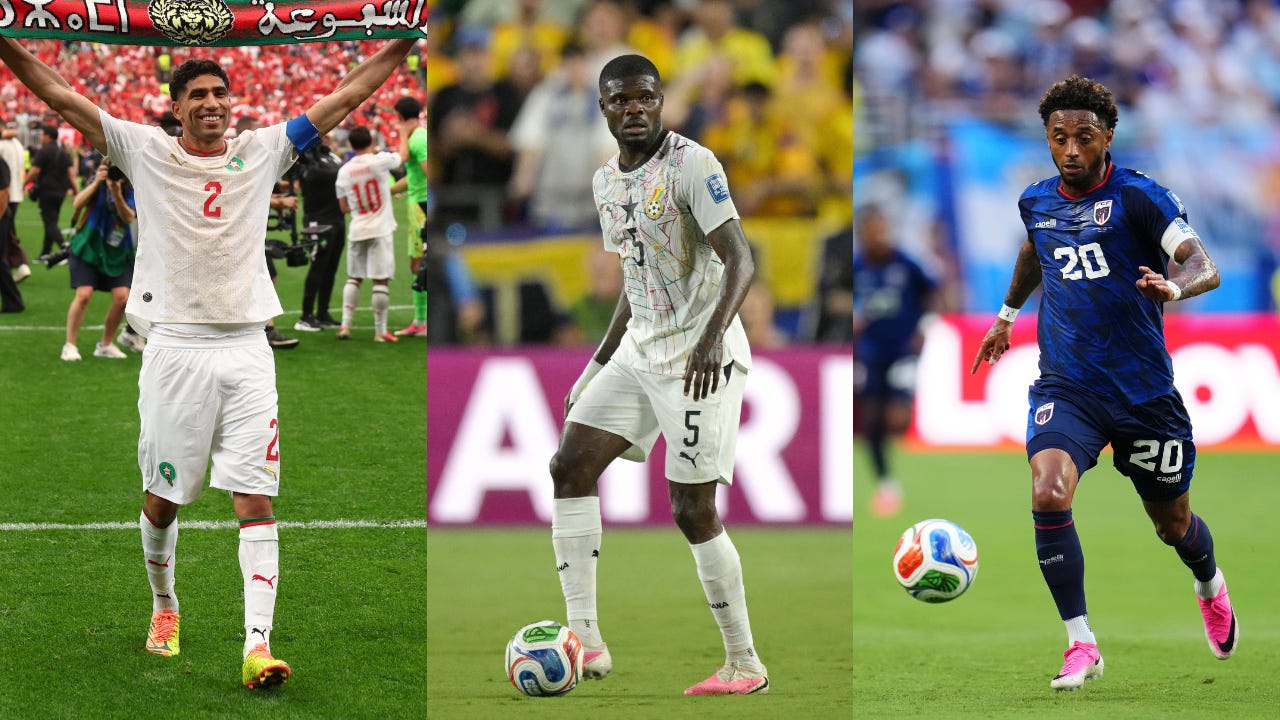
Thomas Partey of Ghana is facing seven counts of rape and one count of sexual assault brought by four different women in England, according to The Athletic. He was first charged in July 2025 and faced two additional counts in February 2026. He has pleaded not guilty to all charges and denies any wrongdoing. His trial is expected in 2027 at Southwark Crown Court. Ghana coach Carlos Queiroz justified his inclusion on the grounds of “the presumption of innocence.”
However, Partey’s participation required some maneuvering. His original visa application to Canada stated he had no criminal charges, which was inaccurate given the charges against him. Canadian authorities denied him entry, and he missed Ghana’s opening match in Toronto. He played freely in the United States.
Morocco’s captain Achraf Hakimi, widely considered one of the best defenders in the world, will stand trial in France for rape stemming from a 2023 allegation. He lost his appeal during the second week of the World Cup, according to Front Office Sports. He denies the allegations. Morocco coach Mohamed Ouahbi has said the team is “behind” him, according to ESPN. During Morocco’s penalty shootout, Fox Sports lead analyst Stu Holden called Hakimi the team’s “star man” before listing his accolades. Hakimi missed his kick. Morocco is still advanced.
Similarly, Cape Verde captain Ryan Mendes is under active police investigation in New Zealand for allegedly raping his team’s FIFA liaison during a tournament in March 2026. He has not publicly commented. And Cape Verde’s federation did not respond to requests for comment.
For his part, Japan’s Kaishū Sano was arrested in July 2024 after he and two others allegedly gang-raped a woman at a hotel in Tokyo, according to South China Morning Post. During interrogation, he reportedly denied the allegations, and charges were dropped after a private financial settlement with the victim. Sano then publicly offered what he called a “sincere apology to the victim for my actions that caused great trouble.”
The Japan Football Association categorized the incident as a “personal mistake” and issued no long-term ban or expulsion from the national team. Meanwhile, Sano scored Japan’s only goal in a 2-1 Round of 32 loss to Brazil. Similarly, his teammate Junya Ito was investigated for sexual assault in 2024, denied the allegations, and sued the woman who accused him. Prosecutors dropped the case, citing a lack of evidence. The woman’s lawyer called that outcome “extremely unjust.”
But nothing of this is new. Portugal’s Cristiano Ronaldo has been in and out of courts for nearly two decades over a woman’s allegation that he raped her in Las Vegas in 2009. The two settled in 2010 for $375,000. She sued again in 2018, claiming she had been pressured into the settlement and a non-disclosure agreement. The case was dismissed in 2022. Her appeal was denied in 2023.
Meanwhile, Ronaldo has denied the allegations throughout. He even appeared at the White House alongside Donald Trump as part of a Saudi delegation in November 2025. He scored for Portugal against Croatia on July 2 before Spain eliminated the team on July 6.
FIFA’s Response Has Been Consistent: Silence
When Front Office Sports asked FIFA for comment on the multiple players competing under rape or sexual assault allegations, the organization did not respond. Regarding Ryan Mendes specifically, FIFA said in a statement that it “takes any allegation of misconduct extremely seriously.”
Jennifer Simmons Kaleba, a spokesperson for the Rape, Abuse & Incest National Network, told Front Office Sports what that statement amounts to: “That’s the standard line we hear whenever any organization’s governing body is looking into accusations of sexual assault. But taking sexual assault charges seriously should also include creating and insisting upon environments where the behavior is neither tolerated nor swept under the rug.”
Canada Was the Only One That Drew a Line
When Canada denied Partey entry, court documents showed immigration officials making a specific distinction. The fact that Partey had not been convicted was “irrelevant” to their analysis. “Given the explicit nature of the allegations in the indictment, it was open to the (immigration) officer to conclude that the applicant committed serious acts of sexual violence that render him inadmissible to Canada,” the documents read.
Canada recognized a difference between the presumption of innocence, which entitles someone to a fair trial, and the assumption that nothing should change until a verdict arrives. No other country, federation, or governing body did so at this tournament.
The NFL, in contrast, has a publicly available conduct policy that reads: “It is not enough simply to avoid being found guilty of a crime in a court of law. We are all held to a higher standard and must conduct ourselves in a way that is responsible, promotes the values of the NFL, and is lawful.” FIFA has no equivalent.
Football journalist Cerys Jones, who spent months investigating football’s relationship to violence against women, wrote in The Athletic: “If the issue is not thrust into the spotlight by high-profile allegations, football does not give violence against women a second thought. Decision-makers do not consider it worth their time to come up with clear policies, or consider the message that they want to send in these situations — both to players about what is acceptable and to survivors about what the consequences will be of them coming forward.”
The World Cup final is on July 19. The list is eight names long and not getting shorter.