

Is Karol G Building the Biggest Cultural Reset in Latin Music?
When Khloe Kardashian promotes your music, you're not the one crossing over.
When Karol G released MATADORA as the opening salvo of her sixth studio album, many were excited for a possible return to original reggaeton. However, we began to see that the subsequent promotional campaign included social media posts from Khloe Kardashian and Jessica Alba. In certain corners of the internet, the sigh was inescapable. “There she goes. The crossover has begun.”
The Colombian reggaeton star who built a stadium-level career entirely in Spanish might now be following in Shakira’s footsteps from two decades earlier: donning the blonde, giving English-language interviews, and courting the Anglo proximity that, slowly but surely, turns Latin music stars into a digestible bite for the American mainstream.
However, there might be something else in the works here.
Karol G’s Numbers Speak for Themselves
In 2023, CNN and the Business of Fashion published what was arguably the first comparative data on Karol G. At the time, they highlighted how, while Kim Kardashian had more than five times Karol G’s Instagram followers, Karol G’s engagement rate was 5.8 percent. Kim Kardashian’s was 0.4 percent. It was the first time a massive media outlet recognized the importance of engagement vs. following.
And don’t get us wrong. By 2022, Karol G was already a megastar in her own right. She had already secured her third consecutive year as the most-streamed Latin American female worldwide on Spotify, and a year later, her 2023 album, Mañana Será Bonito, became the first Spanish-language album by a woman to debut at number one on the US Billboard 200.
Fast-forward three years. In April 2026, she became the first Latina to headline Coachella. And now, this past week, Pitchfork reported she became the first solo woman in history to headline Rogers Stadium in Toronto. She has her own record label, her Con Cora Foundation, and is, under any angle, the epitome of success. And now, Khloe Kardashian is promoting her song on Instagram, and the overall aesthetic trend across the internet increasingly resembles Karol G.
So, does she need a crossover?
The Move Shakira Made May Not Exist Anymore
The same year Karol G was catapulted to global success, Isabella Gomez Sarmiento at NPR reminded us Shakira’s stardom “occupies a particular place in pop music, one that arguably no longer exists: the Spanish-to-Anglo crossover.” Julio Iglesias, Gloria Estefan, Ricky Martin, and Selena had all found their way to American charts before her. Shakira may have been the last to perform the classic maneuver in its original form, the one requiring new language skills, a new hair color, and a reformatted sound for an audience that had not yet learned how to meet Latinos halfway.
In 2001, when Laundry Service arrived, Shakira needed top-40 radio airplay to play her music. Radio needed to push play first. Gloria Estefan advised her, per NPR, that a predominantly English album was the price of entry. Understandably, fans in Latin America called it a sellout. Entertainment Weekly’s David Browne called it, at the time, “the ultimate in crossover nightmares,” a review cited by NPR. Shakira told Variety years later: “Laundry Service was 100 percent a before-and-after moment. My life wouldn’t be remotely the same had I never taken that leap.” She also told Variety: “It’s true that now Spanish has become mainstream, but breaking through that barrier at the time was so important, not only for me as an individual but also for the culture I was representing.”
The barrier she described is now closer to an open door.
Latin music streams surged nearly 170 percent worldwide over the five years before 2023, according to Spotify data. Leila Cobo, Billboard’s chief content officer for Latin and Español, told CNN that year: “There aren’t as many gatekeepers as before.” Gomez Sarmiento at NPR wrote: “It’s now American artists, in an industry radically changed by global forces in streaming and social media, that must tap into non-English markets.” Cobo also told CNN: “Karol’s not just a reggaeton artist anymore. She’s become a pop artist.”
Shakira had to engineer that market, a world willing to receive Spanish-language music as legitimate pop. For Karol G, the story is different.
What Karol G Has Said About Never Changing to Get Here
For an outsider, the pattern looks familiar. The blonde hair, the Anglo interviews, the celebrity campaign for MATADORA… These are choices that read as the classic crossover, even when the underlying power dynamic has shifted. The question many might be asking themselves here has real teeth.
Karol G has been making her position on this clear for years, and she has made it in moments that cost her something to say.
In 2023, when GQ Mexico published a cover that photoshopped her image, she called it out directly on Instagram. “My face does not look like this, my body does not look like this, and I feel very comfortable and happy with how I look naturally,” she wrote. Subsequently, she pulled the cover into her own platform and named what had been done.
That same year, speaking to CNN and the Business of Fashion about her fashion breakthrough, she said: “You know, I never thought that being faithful to who I was — not following what’s in or out of fashion and not having to change myself to get there — would bring me such a platform.” She told CNN that she will never give up her hoop earrings, which she has worn through every era of her career, because they symbolize her roots in Colombia’s urban street culture. “I won’t stop doing something that truly represents me,” she said. “I’m very careful about that.”
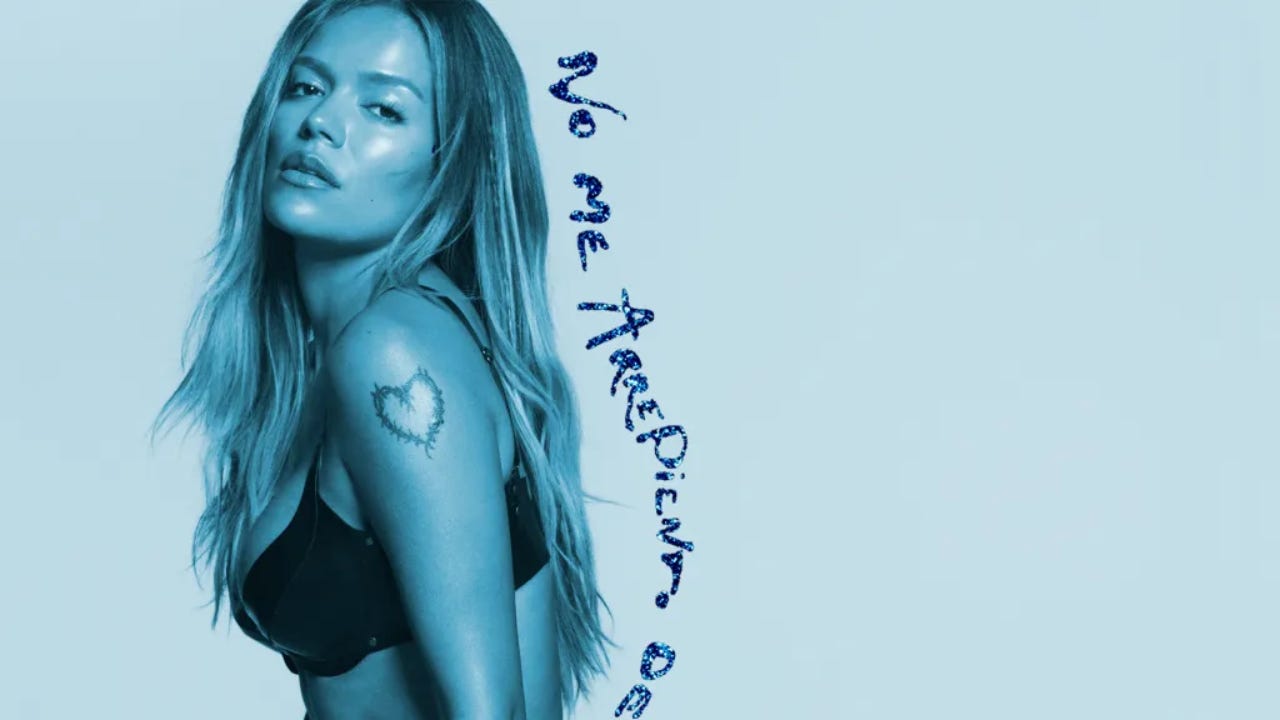
Her new album, No Me Arrepiento de Sentir Tanto, which translates as I Don’t Regret Feeling So Much, arrives August 7. It is mostly in Spanish and was recorded in isolation in Hawaii, hiking alone through the mountains and writing from the inside out. “In making this album, I put a lot into being alone,” she told Elle. “I learned a lot about enjoying my solitude in this industry. We are really, really lonely. Compared to the rest of the world, you’re very isolated.” Its lead single, MATADORA, produced by Tainy and Cashmere Cat and released during the opening night of her Viajando Por El Mundo Tropitour in Chicago. The album cover shows her with a serious expression, a glitter-pen title wrapping her body, in the baby blue she has used across all her promotional imagery for months.
“The next version of me will be new to people,” she told Elle, “but it’s always been there, dormant.”
Until now, the evolution she describes has originated from within, like a dormant volcano waiting to surface. The crossover concept, by definition, requires an external pull: a market to enter, an audience to win over, a language to adopt. A crossover asks an artist to move outward. If it were true for Karol G, she might be taking a detour.
But what will it look like?