

Can You Actually Protect Yourself from the "Pervert Glasses"?
Meta's smart glasses have made every public space a potential filming set. Here's how people are pushing back.
A woman called Manic Muse, a DJ and music producer, gave her number to a man who approached her in a Texas grocery store. At first, the interaction seemed normal. It was a conversation, with an exchange of contact information. What she didn’t know was that he was wearing Meta Ray-Ban smart glasses. The camera built invisibly into the frames was recording the entire encounter. He would eventually post the footage online without her permission despite her direct message asking him not to. The video received 23 million views. “It’s just so violating,” she told Mashable. “I didn’t consent to being secretly recorded, and I definitely didn’t consent to becoming content for millions of strangers.”
The glasses have been on the market for a year now, and by the first quarter of 2026, Meta held 69.2% of the smart glasses market, with shipments surging 167% year over year to roughly 2.25 million units.
The phrase now circulating online to describe them is “pervert glasses.”
Meta Glasses Look Like Ray-Bans, And That’s the Whole Problem
Meta’s Ray-Ban smart glasses look, for all practical purposes, like a pair of Ray-Bans. They can answer questions, translate language, capture photos, and livestream hands-free. The camera is built into the frames. A small white LED is supposed to flash whenever a video is being recorded, signaling to wearers and bystanders that the device is active. Meta has repeatedly said that this light cannot be turned off.
However, as it often happens, people are already finding ways to circumvent this. Some are selling stickers online to conceal the indicator anyway. And per the Wall Street Journal, people in at least 30 states have offered services to modify it physically.
The Women Being Turned Into Content Without Knowing It
In less than a month, aspiring influencers and pickup artists have built entire accounts around filming themselves approaching women. They approach them in grocery stores, gyms, airports, malls, and on public transit, then upload the footage. Then, audiences who never meet the women in question are invited to evaluate them inch by inch.
Former prank creator Brad Podray, who previously operated under the name Scumbag Dad, described the targeting logic to Mashable in January: “They want people who are good on camera, so they’re going to hit fast food employees, and they’re going to hit pretty girls. A lot of random women walking around aren’t going to want to participate in a skit if you ask them to, so they remove the agency entirely by just running the glasses.”
The Public Response Came Quickly
In May 2025, Spanish authorities in Barcelona arrested a man who had used Meta glasses to secretly record more than 320 videos of women in public spaces, uploading the footage to promote paid “seduction” and pickup courses, per Cultura Colectiva.
Similarly, in late 2025, the University of San Francisco’s Department of Public Safety issued campus-wide alerts. The announcement came after a man wearing Meta glasses reportedly approached female students with unsolicited romantic comments and posted the footage on a TikTok account called pickuplines.pov. Now, investigations by the BBC, CNN, and The New York Times identified dozens of accounts built entirely around covertly filming women in gyms, airports, malls, and on public transit.
The Footage is Only the Beginning of the Harm
Once a video is online, viewers scrutinize the woman’s appearance, sexualize her, criticize how she handled the encounter, and sometimes search for personal information. We are suddenly part of a virtual Roman circus we never agreed to in the first place.
Researchers at Harvard have already demonstrated that pairing Meta glasses with public facial recognition software can allow wearers to identify strangers’ names, addresses, and family members in real time, per Cultura Colectiva, which turns being filmed in public into a genuine safety threat.
Thorin Klosowski, a security and privacy activist at the Electronic Frontier Foundation, explained how, with the glasses, it’s just “fundamentally, completely, utterly different.”
“Unless you’re literally in front of them, you don’t know whether it’s recording or whether they’re taking photos.”
Meta Banned the Content It Created the Conditions For
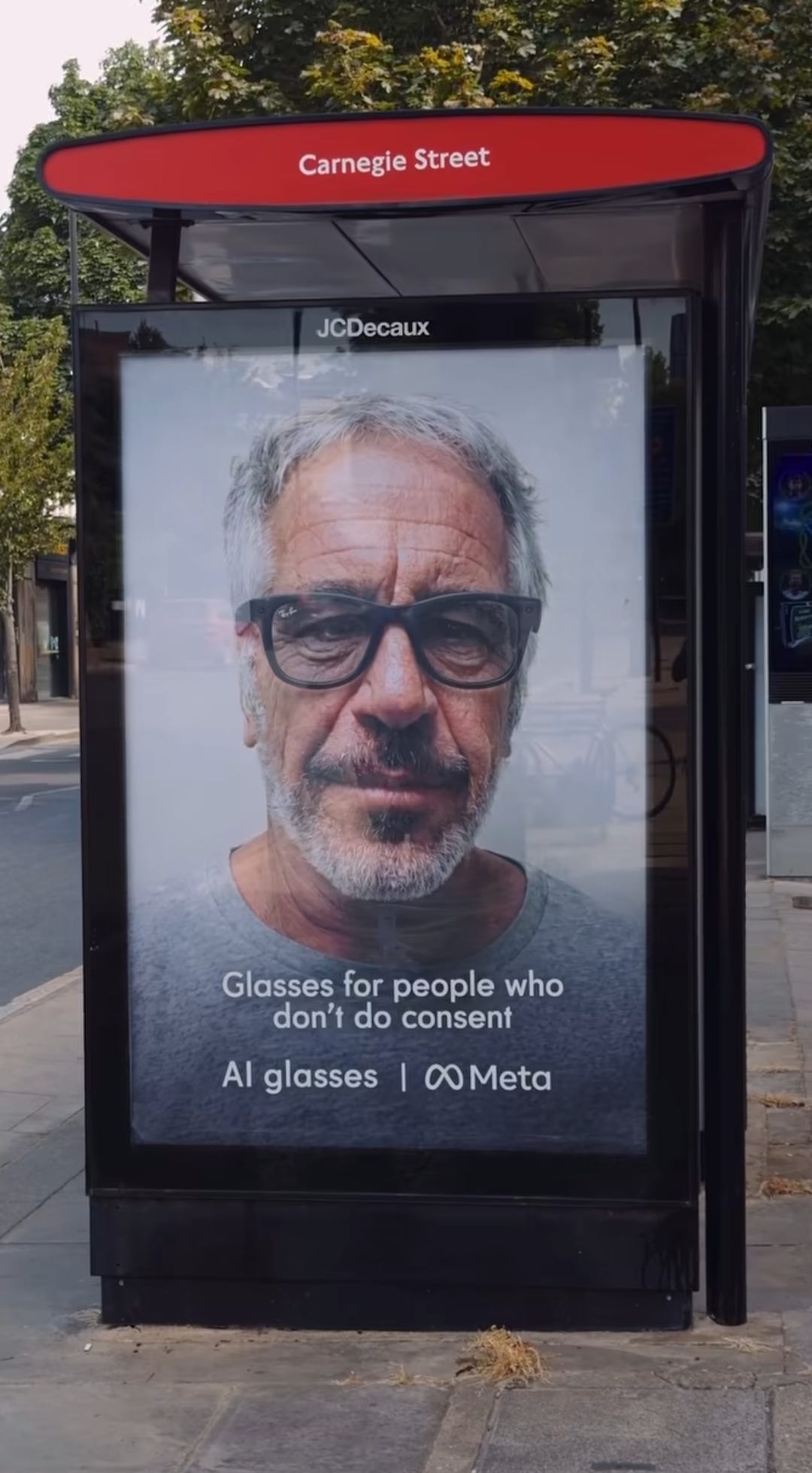
The backlash became loud enough, and literal enough, to be impossible for Meta to ignore. Activists plastered anti-smart glasses posters across New York. In London, an activist group called Everyone Hates Elon placed an advertisement at a bus station near Meta’s King’s Cross office showing Jeffrey Epstein wearing a pair of the glasses with the caption: “Glasses for people who don’t do consent,” per Futurism.
When your product has been placed on the face of a convicted sex criminal as a joke that makes perfect sense to everyone who sees it, you have a problem that a content moderation policy cannot fully address.
Instagram head Adam Mosseri announced that content “taking advantage of people and harassing them, like a lot of these pickup line kind of videos,” would be removed from the platform. Meta, Instagram’s parent company, confirmed it had deactivated two accounts, each with more than 1 million followers, for violating its harassment policies by posting content about smart-glasses pickup.
What this means in practice: Meta built and sold a product whose users behaved so objectionably that Meta felt compelled to ban the resulting content on Meta’s own platform, as The Verge’s Mia Sato put it, as if to say, “Stop making us look bad.” Meta spokesperson Albert Aydin told The Verge the company was working on disabling cameras when tampering is detected. Aydin did not answer questions about whether a person who was filmed could appeal to have the content removed. The actual written policy was not provided to The Verge.
The Structural Problem With the New Policy Is Not Its Existence but Its Limits
Right now, social media moderation begins only after footage has already been posted. If you discover you are in a clip, you must find the video, locate the account, file a report, explain the violation, and wait for a platform decision, all while the clip accumulates views and gets copied to other accounts.
This means the policy addresses harassment and exploitation explicitly but leaves a wide gray area for invasive recordings that do not clearly rise to either definition. As The Verge noted, Meta is trying to have it both ways: touting enforcement while creating the conditions that made enforcement necessary.
Even Apple noticed. Per Bloomberg’s Mark Gurman, Apple is delaying its own smart glasses to WWDC 2027 in part to build in privacy protections, including on-device AI processing, no facial recognition, and a pledge not to use customer recordings to train AI models. Apple has also considered removing video-recording capabilities entirely, though doing so would undermine one of the product’s core selling points, per Mashable. The company’s calculation is not hard to read: “pervert glasses” is now a phrase, and whoever comes to market next will be judged against it.
How to Protect Yourself When the Law Won’t
The internet’s most viral answer to this problem is also the most honest about its own limits. The advice circulating on LinkedIn, Threads, and X is to play a Disney song loudly if you suspect someone is filming you, on the theory that platforms like YouTube and Instagram use automated copyright-detection systems to flag copyrighted audio and block the upload.
The sad part is that, as many are saying online, “music is more protected than women.”
But does it work? The real answer is sometimes, imperfectly, and only if you notice in time. YouTube’s Content ID system can detect copyrighted audio. Still, the most common result is not removal but redirection of ad revenue to the copyright holder, meaning the video stays live. TikTok typically mutes the audio while leaving the visual content intact. Therefore, creators can strip the audio, replace it with AI-generated audio, or shorten the clip before uploading.
The execution window is also brutally short. You would need to spot the tiny white LED, recognize what it means, confirm it hasn’t been covered with tape, unlock your phone, open a music app, and hit play before the conversation ends. By then, you are, in all likelihood, already the content.
Two detection apps are worth knowing about, limitations included.
Antizuck Smart Glasses Scanner, available for iPhone at $2.99, scans for Bluetooth signals matching Meta glasses, Snap Spectacles, and other wearable devices, and records whether a nearby device has been detected before. The catch: it only detects Meta glasses when they are charging, powering on, or actively pairing, not while recording mid-conversation. Nearby Glasses, an Android app developed by Yves Jeanrenaud, uses the same Bluetooth-scanning principle and can produce false positives. Jeanrenaud described the app to TechCrunch as “a desperate act of resistance, hoping it would help at least someone.” He is not wrong that it is desperate. He is also not wrong that it might help.
The more structural protections are institutional bans, which have begun to accumulate.
New York prohibited recording-enabled glasses inside every courthouse in the state’s Unified Court System as of July 20, 2026. Monopoly Events, which runs Comic-Con shows across Edinburgh, Aberdeen, Manchester, Liverpool, Birmingham, and much of England, banned Meta glasses and all wearable recording devices after celebrity guests said they would stop appearing at events if covert filming continued, per the BBC. CalMac, a Scottish ferry operator, paused bridge visits for passengers after a man was caught filming crew and passengers with Meta glasses.
In fashion spaces, a quieter form of resistance is also taking shape.
Designers are now building adversarial patterns into clothing, carefully designed arrangements of shapes and colors that exploit weaknesses in computer vision systems and confuse facial recognition algorithms. Brands like Cap_able and Urban Privacy are already marketing these garments to a growing audience, per The Guardian. Experts observe that effectiveness varies by surveillance system and conditions.
Dr. Jennifer Bell, a senior lecturer in creative AI, fashion, and digital culture at Nottingham School of Art and Design, told The Guardian: “Even if the designs don’t necessarily work perfectly, fashion is also a visible sign of resistance. This is consumers collectively coming together to make a visible statement.”
That is what most of these tools are: visible signs of resistance in the absence of effective law. Recording someone in public is not universally illegal in the United States, and laws around audio recording, sexual imagery, harassment, and commercial use of someone’s likeness differ greatly by state, per Mashable. The law built to address consent was written for an era where cameras were visible, one where you could see them and decide how to respond, and this world is not that one. In the meantime, the women are left with Disney songs, $2.99 apps, and clothing designed to confuse an algorithm. It is not enough. But it is what exists, and knowing what it can and cannot do is at least a start.