

Aren’t we tired of apologizing on behalf of men?
From Hillary Clinton to Team USA, women keep cleaning up men’s messes. When does it stop?
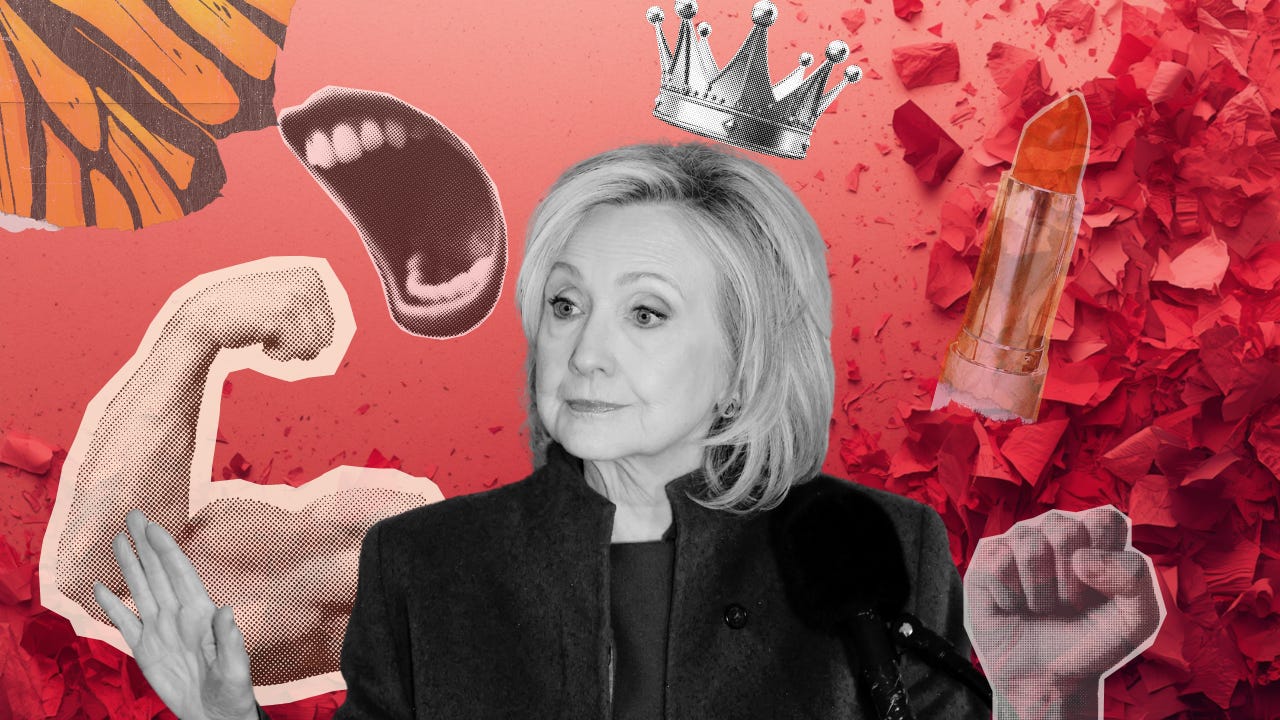
Over the last twenty-four hours, we have witnessed a striking tableau. Former Secretary of State Hillary Clinton stood before lawmakers and faced questions about what her husband, former President Bill Clinton, may or may not have done in connection with convicted sex trafficker Jeffrey Epstein. Once again, a woman answered for a man.
Days earlier, the United States women’s hockey team confronted a similar dynamic. After President Donald Trump made locker room comments to the men’s team, the women’s team faced the fallout. These athletes, who actually secured the gold medal, declined the president’s invitation to the White House.
“We are sincerely grateful for the invitation extended to our gold medal–winning U.S. Women’s Hockey Team and deeply appreciate the recognition of their extraordinary achievement,” a USA Hockey spokesperson said.
“Due to the timing and previously scheduled academic and professional commitments following the Games, the athletes are unable to participate.”
Once again, women chose restraint in response to male impertinence.
How long will women continue to make excuses for men?
For centuries, society has trained women to apologize on behalf of others. Specialists describe this pattern as “emotional labor,” particularly when women regulate emotions, clean up messes, mediate conflict, and preserve harmony in professional and domestic spaces.
Women of color know this terrain intimately.
Systemic expectations weigh heavily on our shoulders. We are expected to soften our presence, to appear less threatening, to maintain calm in moments when others lose it. We perform this balancing act to protect our careers, our reputations, and sometimes our safety.
The cost accumulates, and then emotional exhaustion sets in. Career stagnation is also a risk, while the burden rarely distributes evenly.
The ritual of the “Inappropriate Apology.”
Consider how often we witness the same script: A man drinks too much, makes an offensive remark, or loses control. Immediately, a woman steps forward — a mother, grandmother, an aunt, a partner. Sometimes ourselves. She apologizes for behavior she did not commit.
Meanwhile, the man remains silent or walks off easily.
In columns such as Jessica Valenti’s Why Men Won’t Apologize, and in conversations initiated by Kacy Preen, observers point to a pattern: men appear unable to apologize, in part, “because they think they are entitled to forgiveness.” Society often conditions women to supply the forgiveness that allows men to evade consequences and continue the behavior. Preen argues that “these powerful men don’t think they should have to apologize because they don’t think they did anything wrong in the first place.”
What if we stop?
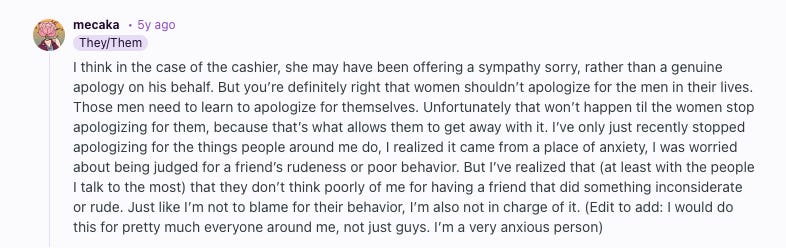
In the popular Reddit thread “Two X Chromosomes,” many women converge on a blunt conclusion: “Women shouldn’t apologize for the men in their lives. Those men need to learn to apologize for themselves. Unfortunately, that won’t happen until women stop apologizing for them.”
Users echo the sentiment: “That’s what allows them to get away with it.”
“Just like I’m not to blame for their behavior, I’m also not in charge of it,” one user wrote.
“Put the ball back in the guy’s court (LOUDLY),” said another.
The advice that surfaces repeatedly is deceptively simple: “If you need to apologize for someone else, stop and think about why you are doing it.” One commenter elaborated, “Examine why you are apologizing for them, and consider if they have ever apologized for themselves.”
Perhaps that is where the shift begins. Not with a grand gesture, but with a pause. A refusal. A decision to let accountability land where it belongs.