

Are Some Conservative Women Actually Surrendering the Vote?
106 years after women won the right to vote, some conservative women say they’d willingly give it up.
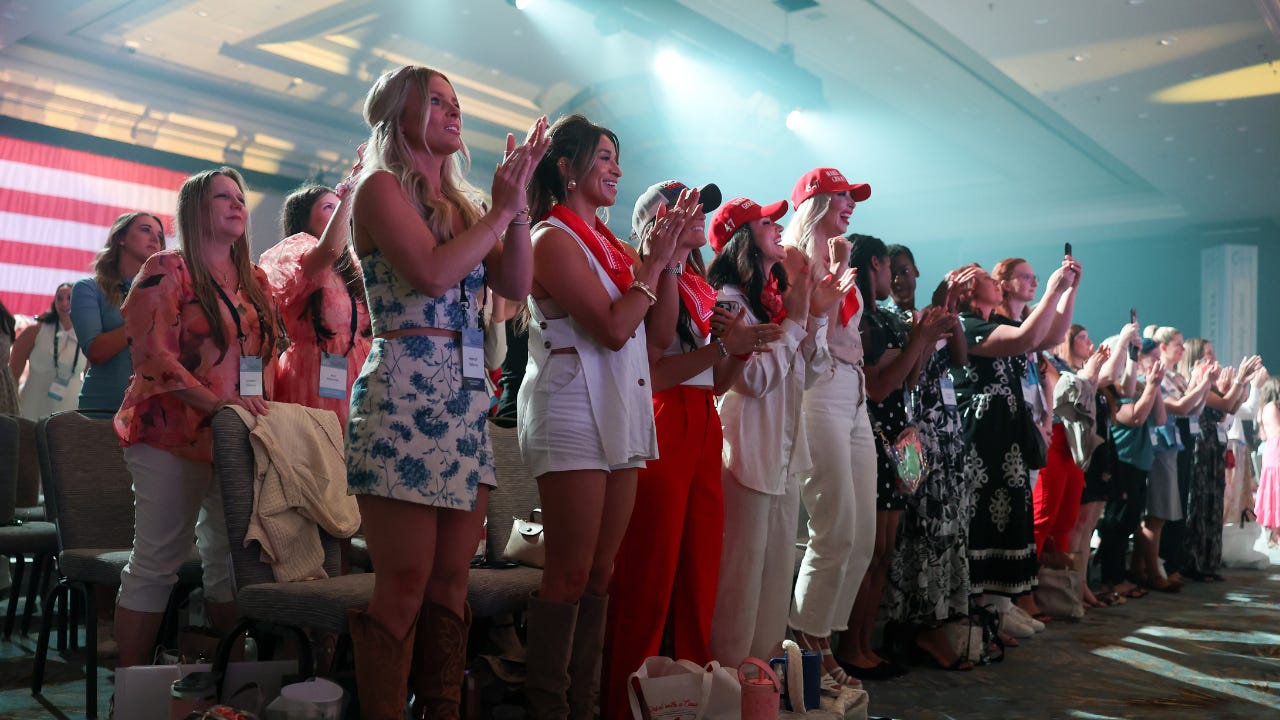
American women won the right to vote in 1920, when the 19th Amendment was ratified. One hundred and six years later, in San Antonio, Texas, some women at a conservative summit said they would hand that right back to their husbands.
This is worth slowing down for.
What TF Happened in San Antonio?
The Turning Point USA Women’s Leadership Summit convened in San Antonio, Texas, during the first weekend of June 2026. Approximately 3,000 mostly young Christian conservative women attended. TPUSA has been led since last fall by Erika Kirk, the widow of founder Charlie Kirk, who was killed during an outdoor college debate in Utah in September.
Keynote speaker Savanna Stone, a 21-year-old conservative content creator with approximately 800,000 followers across platforms, presented the concept of household voting to the crowd. The idea holds that one vote per household, cast by the male head of that household, should replace individual voting rights.
Several attendees told reporters they would accept that.
Alexus DeGraaf, 31, from Columbus, Ohio: “My perspective as a Christian woman is that my husband and I are one flesh. I vote the same way he does, so honestly, I would be okay with giving up my right to vote, because I know that he would represent me well.”
Brooke Foxworthy, 48, a stay-at-home mother who had recently relocated from California to Texas, put it this way: “If my husband’s the head of the household, I am the neck, and we work very cohesively together. If he were voting on behalf of our household, I would be fine with that,” per CBC. She said she would apply the same arrangement to her daughter.
KayElah Gardner, 19, a nursing student from San Diego, told CBC she would give up her vote if it led to the elimination of abortion access.
The framework these women are drawing from is biblical patriarchy, a belief system rooted in Ephesians 5:22, “Wives submit yourselves to your husbands as you do to the Lord,” which holds that men should lead in both family and civic life, per The Meteor.
Defense Secretary Pete Hegseth has publicly amplified a version of this argument, reposting a video of Doug Wilson, an Idaho pastor, advocating against women’s suffrage. Hegseth’s family attends Pilgrim Hill Reformed Fellowship in Tennessee, part of Wilson’s Communion of Reformed Evangelical Churches network.
Where This Idea Comes From
Conservative thinkers first raised the concept in the 1980s, drawing from pronatalist movements in Europe, per The Meteor. It gained organized momentum in the United States during the 1990s and 2000s under Doug Phillips, the founder of Vision Forum Ministries.
Historian Beth Allison Barr traced the concept to its roots in an interview with Katie Couric Media: “The householder was the wealthy white man who had the vote. So it was more about class privilege and racial privilege.”
Historian Kristin Kobes Du Mez identified what has changed about the current moment: “These ideas are being platformed more brazenly and more unapologetically, and moving from a kind of quiet subculture into the mainstream.”
Tia Levings, a survivor and author who has written about escaping biblical patriarchy, added: “When proponents of these ideas aren’t able to legislate these changes, they will get women to self-subjugate.”
Not Everything Is That… Grim?
The images that circulated from San Antonio focused on the women who said yes. The fuller picture, per CBC, is that the vast majority of attendees pushed back on the idea of household voting.
Emmy Mills, 20, from Greenfield, Indiana, offered one of the sharper responses: “Not all of our destinies are to get married and have kids,” per CBC. Her point names a structural problem with the model itself. Household voting, in every version on record, assumes a married woman with a politically engaged husband. Most women on earth do not live that life.
But The Fact That Some Women Are Already Indoctrinated Should Scare All Of Us
“When you give up your voice, you give up your rights,” Levings concluded.
Women won the right to vote in America in 1920 after more than seventy years of organized struggle. Suffragists were arrested, went on hunger strikes, and died for it. They fought for an unwavering mission: the right of every woman to cast her own ballot. The women in San Antonio were free to attend that summit, hold those beliefs, and cast their votes in November because of those seventy years of work.
And yes, faith is a private matter. How any woman chooses to vote is entirely her own. However, a policy of household voting removes the choice.